How do large companies analyze and solve complex supply chain challenges? For over a decade, Optilon has helped one of the world’s leading companies in food processing and packaging with supply chain design and network optimization. The result? Improved structure, faster workflows, and greater efficiency.

CHALLENGE

How do we design an optimal supply chain? 

For larger companies, which often have larger and more complex supply chains, evaluating investments or divestments is no simple task. It involves more than just analyzing costs or impacts in one single market – it’s about understanding the ripple effects across multiple factors and how your entire network will be affected.

Take a real-life example: About ten years ago, a world-leading food processing and packaging company faced the challenge of closing a factory in Sweden. Shutting down the factory raised critical questions. How will it affect customers who depend on that site for materials? What happens to the equipment? And how will the overall cost structure evolve?

Previously reliant on time-consuming spreadsheets, they recognized the need for a robust solution to address these types of complex supply chain challenges.
Quote-1-Supply-chain-design-–-Business-Analyst-at-one-of-the-worlds-leading-food-processing-and-packaging-companies-1

SOLUTION

Network optimization to ensure a cost-effective blueprint

After exploring various options, the food processing and packaging company chose to partner with Optilon. Through in-depth discussions, we decided to implement a robust system for network optimization – a critical component of supply chain design. While designing a supply chain involves creating a blueprint for how goods, information, and resources flow between locations, network optimization ensures that this blueprint is cost-effective and efficient by analyzing and selecting the best configuration of nodes (such as factories and suppliers) and links (such as transportation and duties).
Our team provided the tools and expertise to guide our customer through every stage, from installation to designing a customized input model. By parameterizing their supply chain in a decision model and integrating it into an optimization solution, we could simulate and optimize various scenarios, such as closing the factory. This allowed our customer to compare their current supply chain network against different scenarios, visualizing how key factors like cost categories, customer supply, lead time, and raw material flows might shift.

During a hands-on collaboration phase, we worked closely to overcome initial challenges and ensure a smooth startup. Once the model was finalized, our aftercare program provided ongoing support to ensure long-term success with the solution.
Quote-2-Supply-chain-design-–-Business-Analyst-at-one-of-the-worlds-leading-food-processing-and-packaging-companies

RESULT

Results and benefits of Optilon’s supply chain design solution

Upgrading to a robust supply chain design solution has delivered significant benefits to the food processing and packaging company, including improved structure, faster workflows, greater efficiency, and reduced operational costs. The implementation of an automated workflow has eliminated much of the manual labor previously required for data management. From a user’s perspective, the company finds this way of working far superior to Excel, as it handles large volumes of data more effectively.

MAIN BENEFITS

  • Improved structure
  • Enhanced capability to analyze complex problems
  • Increased efficiency
  • Reduced costs
  • Improved ability to analyze different business cases

Today, our customer continues to use the network optimization model to address the very challenges they faced a decade ago, including analyzing factory closures and their ripple effects. Building on this foundation, they now tackle scenarios such as demand reallocation between manufacturing sites and evaluating smaller investments like enhancing capacity or capabilities at specific locations.

Results and benefits of Optilon’s supply chain design solution

For instance, the model is employed to assess the impact of relocating a customer from one factory to another. This enables the company to identify opportunities to optimize transportation costs, improve factory utilization, and leverage favorable import-export tariffs. Additionally, by analyzing raw material fluctuations, they can anticipate operational impacts and prioritize suppliers who meet volume targets within desired cost thresholds.

These applications underscore the system’s ongoing value, transforming complex supply chain challenges into actionable insights that drive better decision-making and long-term efficiency.
Quote-3-Supply-chain-design-–-Business-Analyst-at-one-of-the-worlds-leading-food-processing-and-packaging-companies

The company has access to Optilon’s technical support for maintaining and enhancing the solution when needed. This includes assistance with tasks such as upgrading the platform, modeling new problem scenarios, or extending its functionality and structure. However, the solution is designed to empower customers to be self-sufficient, enabling them to operate, adapt, and develop it independently. Optilon’s support is available as a trusted partner to provide expertise and guidance whenever additional help is required.

They also turn to Optilon to meet staffing needs. As a relatively small team with specialized expertise, recruiting for roles requiring deep knowledge and an intricate understanding of the company’s supply chain is challenging. For them, the best way to bridge this knowledge gap in the short term is by engaging a consultant from Optilon.
Quote-4-Supply-chain-design-–-Business-Analyst-at-one-of-the-worlds-leading-food-processing-and-packaging-companies-1

Are you ready to simplify your supply chain challenges?

If you’re facing similar challenges, let Optilon help you turn complex into simple. With a track record of over 1,000 successfully completed projects and a 30-year integration heritage, Optilon is a trusted supply chain optimization partner.


Book a meeting with us to discuss how we can help you design a tailored supply chain solution that aligns with your business goals.

In today’s fast-paced business world, companies often juggle daily tasks with long-term goals. This is where S&OP steps in to help bridge the gap between strategy and operations, fostering better decision-making and teamwork. However, many organizations face challenges like poor implementation or overly ambitious plans. In this article, we’ll explore how to avoid these pitfalls and maximize the efficiency of your S&OP process. This is mastering S&OP 101.

S&OP: A tactical planning process

S&OP is a tactical planning process. Unlike operational or strategic processes, S&OP connects a company’s strategic goals with its operational activities. S&OP occupies the middle ground, bridging the gap where a tactical process may be lacking. It spans a time horizon longer than operational planning but shorter than strategic planning.

Unlike creating a business plan and reviewing it annually, S&OP is an ongoing process that continuously steers the organization toward its goals. It focuses on aligning operational efforts with the strategic direction, ensuring that decisions are made at the right level. This provides clear guidance to those working on the operational front.

The 5 steps of S&OP

In S&OP, there are five steps. Step one is a necessary preparatory step, whereas step two and three are pivotal, as they ensure alignment between what the market demands and what the company can deliver. Step one to four are the repetitive steps followed in S&OP, typically on a month-to-month basis.

Step 1. Portfolio Management

Portfolio Management is an activity that provides input to the following four steps in S&OP by determining which products should be included in the assortment. What products should we introduce, and which should we discontinue? This process ensures a balanced product lineup that aligns with customer demand and company goals.

Step 2. Demand Review

In step two, the focus is on assessing and forecasting market needs on an aggregated level. How much do we anticipate selling, and which product families will be in demand, month by month? This requires consensus across the entire sales organization, focusing on what can be sold. At this stage, it’s not about production limitations but sales potential.

Step 3. Supply Review

Once demand is understood, it’s time to evaluate the company’s ability to meet that demand. Operations, procurement, and logistics teams come together to discuss capacity, inventory levels, and any constraints that may affect production. Can we meet the demand? Do we have the necessary equipment, workforce, and materials in place? This step assesses the feasibility of delivering on sales expectations.

Step 4. Preparing for the executive meeting

By step four, the groundwork has been laid, but challenges may still remain. At this stage, senior management gets involved to address and resolve any remaining issues. Representatives from both sales and operations collaborate to clear the final hurdles, ensuring alignment across departments.

Step 5. Decision Making

In step five, leadership reviews the consolidated data and actively aligns decisions with the company’s strategy – for example, determining which markets will receive supply when demand exceeds available resources. This is where the plan is finalized. Key activities, actions, and even smaller investments are confirmed, solidifying the path forward. 

Common-pitfalls-when-implementing-SOP-as-a-process-1

Common pitfalls when implementing S&OP as a process

When companies fall into chaos, it is often this very chaos that drives change. In the hustle of daily operations – putting out fires, managing fluctuating inventory, and struggling to keep pace with rapid growth – it’s easy to lose sight of long-term goals. Service levels dip, operational inefficiencies pile up, and ambitious targets start to feel out of reach. Meanwhile, the company’s entrepreneurial spirit, where everyone rolls up their sleeves and works harder and harder, begins to look unsustainable.

At this point, it’s important to ask: Can we truly achieve our growth objectives if we keep operating this way? More often than not, the answer is no. The company reaches a point of organizational burnout, where the workload threatens the business’s future.

Rushing into making changes without a structured approach

All too often, companies rush into making changes, jumping straight into the hard work without a structured approach. Before attempting any improvements, it’s crucial to fully understand the existing system. Without this understanding, you’re not truly improving the system – you’re simply making changes. 

Always start with the “why,” followed by the “what,” and lastly the “how.’ The “why” becomes the driving force for change, and this is where the pain points come into play.

The next step is to identify the core issues: Where is the real pain? What’s not working today – and maybe hasn’t worked for a long time? Often, it’s a lack of long-term tactical planning. Companies focus on short-term fixes, overlooking the chance to plan ahead and strengthen resilience.

The absence of well-established operational processes

Another pitfall is the absence of well-established operational processes, such as demand forecasting, inventory management, replenishment planning, and production planning. Without these processes functioning at a high level of quality, it becomes impossible to aggregate plans from the ground up effectively. As a result, decisions made at the executive S&OP level fail to translate into operational success.

Another challenge lies in the disconnect between sales and operations. These teams often function in isolation, tossing demands back and forth and blaming one another when issues arise. Establishing a shared vision for collaboration becomes essential. Company cultures, traditions, and especially divergent reward systems frequently pull departments in opposite directions.

On top of this, poor data control can render aggregated information either incomplete or so corrupted that it’s unusable. This issue spans from inaccurate or incomplete sales data to outdated BOM (Bill of Materials) and capacity data, severely impacting operational efficiency.

The method itself becomes more important than the results

In some cases, the method itself becomes more important than the results. When the focus shifts toward change for its own sake, you loose the original goal of improvement. This often results in friction and transitions that drain energy rather than drive progress.

There may also be resistance right from the outset. People remember past attempts that failed, fostering a mindset of “we’ve tried this before, and it didn’t work.” The organization carries the memory of previous initiatives that fell short, where they missed targets, and ultimately abandoned the effort due to poor outcomes.

How to successfully implement S&OP

You can implement an S&OP process without transforming the entire organization to embrace a process-oriented mindset. With the S&OP process as the base, you are able to describe and perform hands-on activities. Starting small, focusing on critical areas, and building on those successes can lead to meaningful progress without the pitfalls of overambition or resistance. It’s about introducing a new mindset and way of working that prioritizes a holistic view, communication, and continuous improvement.

First and foremost, you need to consider what you want to achieve. Has upper management decided that the company must become process-oriented because it’s the only way to survive? Or is the focus more on continuous small improvements and ongoing development? In the latter case, the chances of success are higher.

It’s also about perspective and method. There are many different methods, approaches, and philosophies, with S&OP being one of them. Companies already have processes, whether or not they formally recognize them. The problem arises because no one actively manages these processes when they go unacknowledged.”

When companies organize by function rather than process, each department focuses on optimizing its own work and results. There’s often little time to communicate. The holistic perspective is lost, and the various functions fail to synchronize. For example, a production department may focus on maximizing its efficiency without considering whether it creates bottlenecks in the supply chain or issues for the sales department. Ultimately, this type of sub-optimization can prevent the company from delivering products on time, in the right quantity, or with the quality that customers expect.

The value of using S&OP as a tactical planning process

S&OP provides a common language across the organization. By helping everyone understand how things work and how different departments interact, it ensures that employees know what to do, when to do it, and how to do it. This approach enables teams to move from reactive firefighting to proactive management.

Once you understand the system, teams can work toward better outcomes. Instead of relying on luck or guesswork when implementing changes, S&OP establishes a “baseline” that tracks progress, identifies areas for improvement, and supports necessary adjustments to drive continuous improvement.

At its core, S&OP fosters a holistic view of the business. It promotes collaboration and open communication, aligning efforts across the organization. By defining clear processes and uniting departments under a shared vision, S&OP ensures that everyone is working toward common goals, with streamlined information flow driving efficiency. 

Establishing a clear structure is also key. By distinguishing immediate operational tasks from long-term strategies, teams can focus on the right priorities at the right time.

Moreover, this structure offers a strategic advantage. When customer demand shifts, the organization can adapt confidently, knowing it has processes in place to handle changes smoothly and without stress. Ultimately, it’s about driving sustainable growth while fostering a healthier organization.

Ready to take control of your operational efficiency?

Don’t let common S&OP pitfalls hold you back. Reach out to our experts today and discover how we can help you implement a streamlined S&OP process tailored to your business needs. Let’s turn tactical planning into a competitive advantage.

Contact us now to get started!

A leading manufacturer of automotive components faced significant challenges in their S&OP process, using manual spreadsheets that hindered efficiency and business growth. With their mind set on transitioning from a people-dependent to a process-driven approach, they turned to Optilon for a robust solution.

CHALLENGE

People-dependent and inefficient planning

The company was facing substantial challenges in their S&OP planning. Many tasks were done manually using spreadsheets, which slowed them down and hindered growth. This manual approach also made it difficult to adapt to changes and make improvements.

They needed a solution that allowed them to plan their sales and operations more efficiently. They wanted to increase their forecast quality to optimize stock levels in their warehouses and provide better service to their customers. It wasn’t just about making things run smoother; it would also be an important step to refining their planning policies.

To achieve this, they had to move away from a people-dependent to a more process-driven approach. It was time to find a robust, sustainable, and reliable solution for their sales and operations planning.


SOLUTION

A smart system for Sales & Operations Planning

After evaluating a pool of candidates, the company invited a select few supply chain partners to present their solutions. After analyzing the pros and cons and engaging in discussions, they chose Optilon, whose S&OP system best matched their business needs.

Collaborating closely with Optilon’s dedicated team, they shared valuable insights about their process, paving the way for Optilon to start the implementation phase. During this stage, Optilon built a customized solution tailored to the customer’s unique business needs.

The implementation phase went smoothly. Optilon provided the customer with structured files detailing the information required for the system. They then extracted and shared data files with Optilon.

An extensive test period proved valuable

Together with Optilon, they devoted over six months to rigorous testing. This allowed them to track and validate outcomes and ensure their new system aligned with their business goals. As some product groups would sell more during specific seasons, they focused on optimizing forecast accuracy and determining minimum stock levels for these groups. The system was set up with multiple individual season keys and forecast models tailored for each specific product group or even item number.


RESULT

Results and benefits of Optilon’s S&OP solution

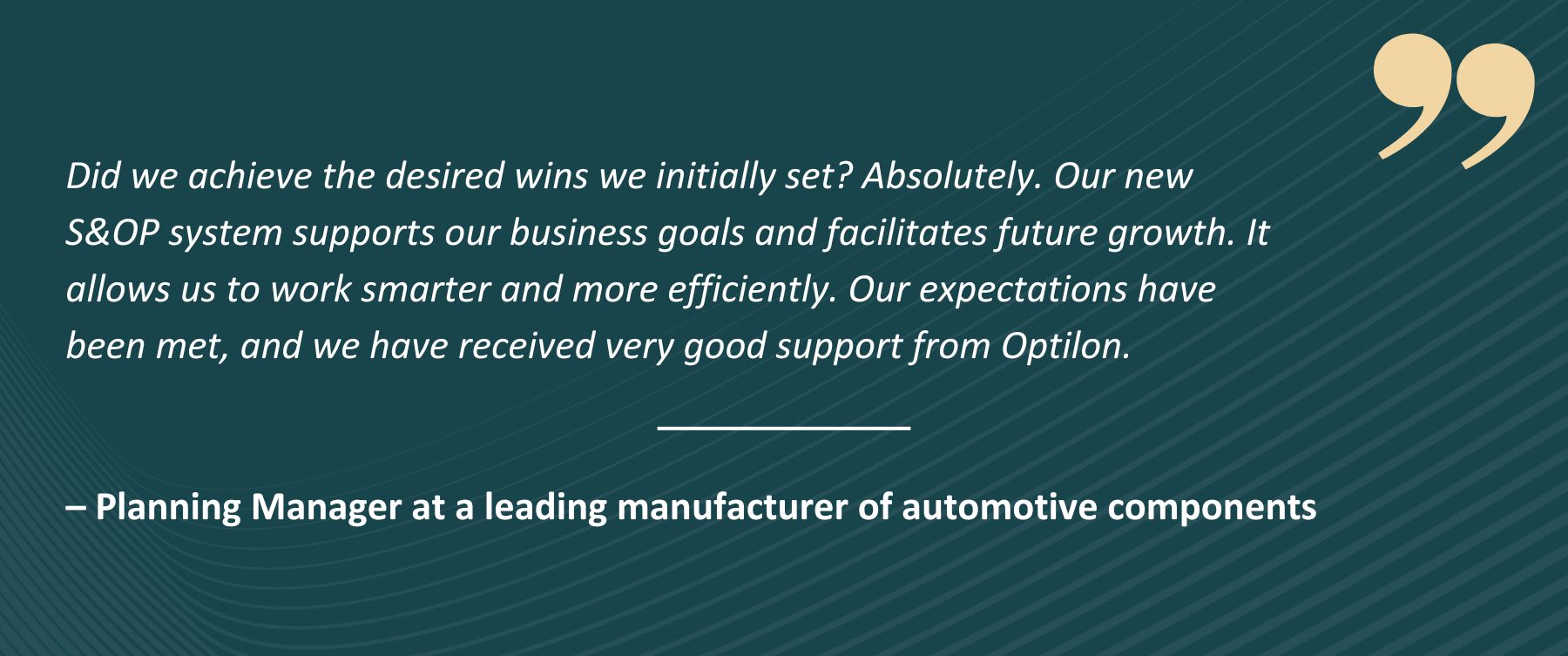
As with most big changes, it took some time for the customer to bring the organization on board. Listening to and getting feedback from the planning team was an important part of building confidence in the new system. But once everyone embraced it, the benefits became clear.

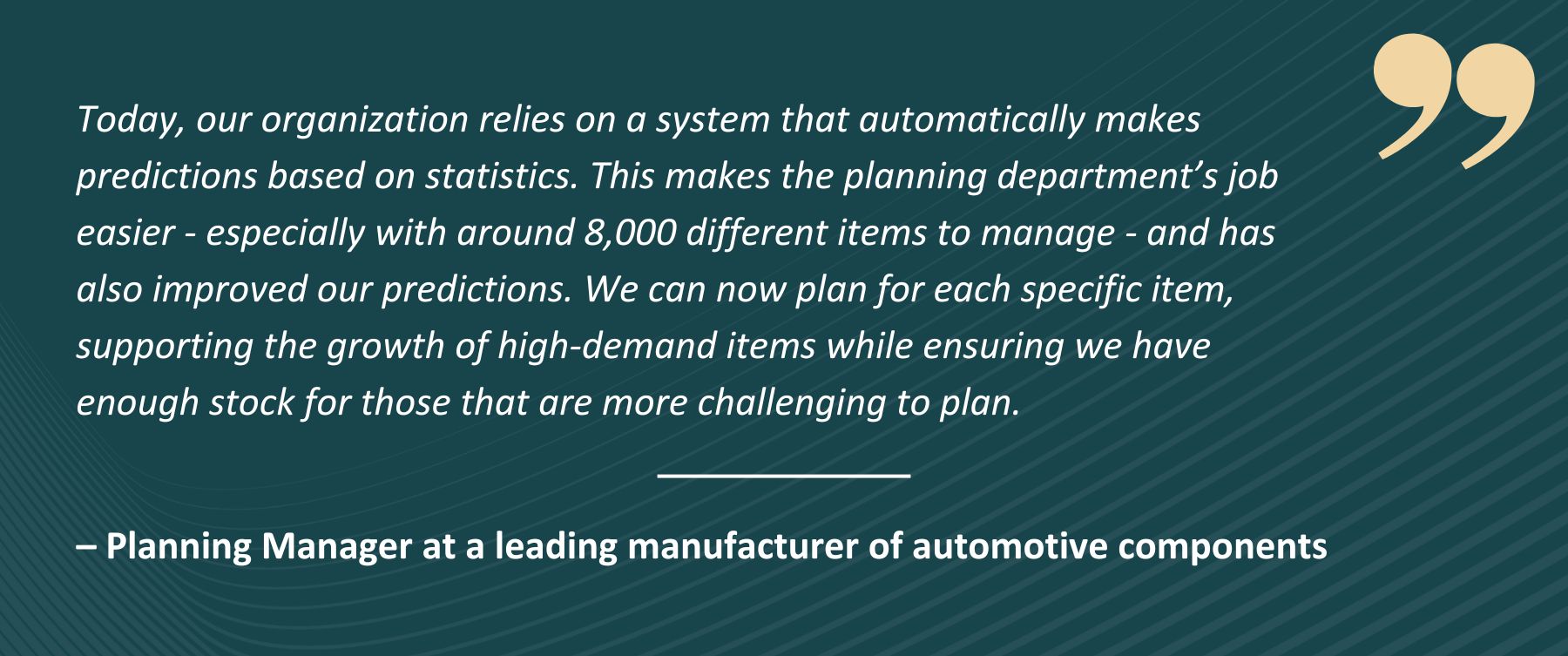
Our customer significantly reduced complexity in their planning department. In contrast to their previous system, which relied heavily on a single individual for manual updates, the new system truly transformed their process. Previously, the weekly task of adjusting reorder points, minimum stocks, and forecasts was laborious and time-consuming. Now, with improved data accessibility, their system remains consistently updated.

They discovered not only newfound efficiency but also other unexpected benefits. The shift from a high-risk, people-dependent setup to a process-driven one also aided digitalization and a shared perspective among team members.

MAIN BENEFITS

  • Optimized sales planning
  • Enhanced operations planning
  • Improved forecast quality
  • Optimized stock turnover
  • Increased growth
  • Enhanced efficiency

The new system has significantly enhanced our customers’ S&OP processes, improving forecast accuracy, optimizing stock turnover, and ensuring OTIF performance. A huge benefit for the company is that it aligns with their ongoing digitalization efforts. They have been able to integrate relevant data into their BI system and now get a full view of everything across the organization. They can share real-time insights, whether dealing with warehouse availability challenges or showcasing their projected trajectory. This allows them to present a clear short-term outlook, ensuring everyone is on the same page, and a long-term perspective, providing a roadmap for the company’s collective future.

Increased growth and transparency

The new S&OP system has also played an important part in supporting the customers’ business growth. In 2021, they acquired a new company, which doubled their planning scope from 8,000 to 16,000 items, achieved with minimal additional resources. By sharing information with suppliers, purchasers, warehouses, and the finance team, they have been able to make more informed decisions and secure the necessary resources for sustained growth. This strategic approach has not only optimized their internal capacities but also enhanced their overall operational efficiency.

Embarking on this sales and operations planning journey, integrating an efficient S&OP process that works has truly paid off for the company. It has brought value across the entire organization and will continue to support their business goals, also in the future.

Are you struggling with your S&OP setup?

Are you relying on spreadsheet programs such as Excel or rule-based processes in ERP systems to manage your S&OP? Have you come to the conclusion that these tools are not sufficient for supply chain optimization and critical business decisions?

With a track record of over 1,000 successfully completed projects and a 30-year integration heritage, Optilon is a trusted supply chain optimization partner.

Book a meeting with us to discuss how we can help you create a tailored S&OP solution that aligns with your specific needs and future business goals.

S&OP is a critical business process for transforming strategy into execution and driving supply chain performance. Even though technology has advanced, many companies are still stuck using old-fashioned and inefficient methods, And there are some big misconceptions that are getting in the way. They exist because businesses don’t fully understand what S&OP is really about. It is time to debunk the myths.

What is S&OP?

Let’s begin by discussing what S&OP – Sales and Operations Planning – actually entails. S&OP is a forward-looking planning process, superior to the operational process and subordinate to the strategic process, bridging the gap between the two. It serves as a mechanism for aligning a company’s strategic objectives with its operational activities. 

S&OP is used to continuously identify disparities between a company’s desired goals and its current trajectory, and find strategies for closing these gaps. This can include a range of actions, such as intensifying sales efforts within specific markets or product segments, increasing manufacturing capacity to meet projected demands, or reallocating resources to areas where they are more effectively used. In essence, S&OP is a structured approach to navigate a company toward its desired future state.

5 myths about S&OP – let’s debunk them

Now, let’s clear up some common myths and get to the bottom of the real value of S&OP.

Myth 1: S&OP is not a relevant operational process today

The concept of S&OP originated in the 1950s, evolving from a production-centric approach to enhance efficiency. It was never designed to be a process for gaining detailed knowledge of every aspect of a company’s operation. Instead of striving for operational precision, S&OP is a tool for planning and fostering flexibility. Today, the fundamental need for tactical planning persists.

Many of today’s companies find themselves caught in the “too late corner.” They primarily focus on assessing their order backlog for the next couple of months, and as a result, they struggle to maintain control and end up spending their time putting out fires.

To overcome this, it is not viable to merely focus on the short term and hope for the best. Looking further into the future and making the most of the information you can capture is essential. Companies must adopt a broader perspective and examine the dynamics of supply and demand across extended time horizons. This entails not only periodic assessments but also frequent monitoring to identify fluctuations and their recurring patterns. A key objective is to understand the flexibility required and how quickly you should adjust your capacity.

Myth 2: It is not worth it, as we cannot predict the future anyway

S&OP is not about predicting the future – it is about planning for the future. Sure, you can use it to analyze historical sales data and create forecasts to align supply with demand. But to unlock the true potential of S&OP, it should be used to understand where your business is today and where you want to be in the future. What is your current trajectory, and what is your desired destination?

This approach places you in control rather than at the mercy of the process. It allows you to gently steer your business in the intended direction. You can accelerate, decelerate, and manage marketing and capacity efforts accordingly.

Used correctly, S&OP is a multifaceted decision-making and gap-bridging process designed to guide your company toward its strategic objectives. It is not about predicting the future – it is about understanding the evolving reality that lies ahead.

Myth 3: S&OP is yet another time-consuming planning process

If this sounds familiar, it might be time to ask yourself this question: How much of your time do you spend on firefighting? The answer might reveal a significant gap in your organizational structure – an absence of a well-defined S&OP process.

As the old saying goes, “If you don’t plan, you plan to fail.” This is especially true when it comes to S&OP. While it isn’t a magic bullet that guarantees flawless outcomes, it serves as a cornerstone for informed decision-making and facilitates a culture of collaboration.

Imagine sending eleven soccer players onto the field without briefing them on their roles, the game strategy, or whether they should play defensively or offensively. Chaos would occur, and the chances of succeeding would be fairly small.

In the world of S&OP, the scenario is strikingly similar. Planning not only saves you from the chaos of reacting to problems as they arise. It also grants you a more transparent path toward achieving your objectives. S&OP, when executed right, is not just another planning procedure, but a value-adding mechanism.

Myth 4: S&OP is solely a supply chain issue

This myth is rooted in a silo mentality where each department operates in isolation, failing to communicate or collaborate effectively. This is often driven by performance metrics solely tied to individual functions. A “you handle yours, and I’ll handle mine” attitude dominates the workplace, and the overall success of the company – which should be the primary objective – becomes overshadowed.

In contrast, S&OP is the opposite of this approach. It shifts the individual focus towards an integrated plan and places the organization within an ecosystem where all departments work together towards a common goal, collectively contributing to the company’s success. The breakdown of traditional silos and adoption of a broader perspective fosters collaboration. Succeeding in S&OP is very much connected to acknowledging interdependence and prioritizing collective performance.

In summary, S&OP is not just a supply chain concern. It is a collaborative effort that involves the entire organization, including sales, operations, product development, finance, sourcing, procurement, and marketing.

Myth 5: A fancy S&OP tool is overkill when we have spreadsheets

Even though technology has advanced, many companies still rely on spreadsheet programs such as Excel or rule-based processes in ERP systems to manage their S&OP. So, isn’t using spreadsheets good enough? Well, it depends on the purpose.

Excel is a great tool for creating prototypes to test ideas in the context of S&OP. However, it is primarily designed for data input and manipulation rather than supply chain planning. As it relies on manual data entry, it has significant limitations in supporting comprehensive planning requirements, making it prone to errors.

The problem usually arises as organizations grow in their product portfolio, markets, or volumes. The more data they put into the system, the more complex it gets. This often leads to shortcuts and inaccuracies, making it inefficient and difficult to manage. Consequently, businesses may experience higher costs and operational inefficiencies.

Relying on spreadsheets for supply chain optimization and critical business decisions simply isn’t sustainable. Companies need to realize that spreadsheets must be replaced with more robust solutions for S&OP that support their future business requirements.

office

Do you want to improve your S&OP process?

Don’t settle for outdated S&OP methods. It is time to say goodbye to manual and tedious Excel corrections and welcome a highly flexible and easy-to-use solution.

With a track record of over 1,000 successfully completed projects and a 30-year integration heritage, Optilon is a trusted supply chain optimization partner.

Our flexible system for S&OP can be tailored to align with your specific processes while remaining adaptable to your evolving business needs. It is easy to implement and offers effortless integration with other systems to streamline your operations seamlessly. Explore our S&OP offer here!

The past eventful years have had a profound impact on global supply chains. It has exposed vulnerabilities in the system and highlighted the need for resiliency. In this context, supply chain design has become increasingly critical. For many businesses, it may seem like a massive challenge lies ahead. But the reality is the time to embrace supply chain is now. Companies that see and make good use of the opportunities presented in this new supply chain era we are entering can achieve significant competitive advantages now and in the future.

Macroeconomic effects on the global supply chain

A lot has happened in the world lately. We are now living with the legacy of a transformation that has taken place in the past few years. It started with the coronavirus outbreak leading to shutdowns of factories as well as ports worldwide. This had a massive impact on global supply chains and challenged many businesses worldwide. Then, as we all hoped the pandemic would be the worst hit of the decade, the invasion of Ukraine happened. Sanctions against Russia, increased inflation rate, and higher global commodity prices, among other consequences, caused further disruptions in global supply chains.

We now find ourselves in a macroeconomic situation where geopolitical events and new economic conditions are forcing companies to really think about their supply chains: How resilient are they? And what is the best strategy to stay competitive in the global market?

The focus has shifted

Five years ago, few raised an eyebrow when businesses decided to source energy from countries such as Russia or move production to low-cost countries such as China. But now, due to the current state of the world and increased vulnerability, priorities have changed. The focus has shifted from keeping costs down to minimizing risk exposure, shortening lead times, improving service levels, and ensuring supply chain sustainability.

Businesses are no longer willing to take the risks involved in long-distance sourcing, and they are becoming more selective in which countries they choose to do business with. At the same time, supply chain sustainability has emerged as a key corporate goal. Due to stricter laws and regulations but also increased consumer demands, businesses must now navigate a new regulatory landscape and manage both supply chain risks and opportunities related to environmental, social, and governance criteria.

Are local supply chains the answer to vulnerability?

As a response, many companies are considering shifting from a global to a regional supply chain setup. While this has quickly become somewhat of a global megatrend, it is, however, important not to jump on the bandwagon just for the sake of it.

Here is an example: A global medtech company provides the European market with hearing aids. They produce their products in China to keep costs down. But now they decide to move their production closer to their customers in Europe. By moving the production to Europe, they hope to reduce vulnerability in the supply chain. However, in Europe, there are no suppliers that can provide the medtech Company with the material they need to produce their hearing devices. The medtech company ends up having to still source the material from suppliers in China. Although production is now closer to their European customers, the problem remains.

Add to the equation the complexity of a much broader product portfolio with multiple suppliers, production sites, distribution points, logistics partners, network nodes, customer segments, and markets – and you can imagine the challenge.

How to design an optimal supply chain

Shifting from a global to a local supply chain setup is not a universal solution that fits all. In fact, there is no “one size fits all” solution for optimal supply chain design. Each company needs to thoroughly analyze their current supply chain setup to design the best solution for their business. The first question to ask is: What is the most important for my business? Is it reducing cost, minimizing risk exposure, shortening lead times, improving service levels, or ensuring a sustainable supply chain?

The answer will be different for every company. Here are a few examples:

For a company that produces standard products, keeping costs down is probably central as their customers are only willing to pay so much. A company that sells spare parts probably prioritizes fast delivery times over cost as their customers will immediately turn to competitors if they have to wait for the products – and they are probably prepared to pay extra for that. A retail company with high requirements for recycling materials and lowering CO2 emissions probably has sustainability on top of its agenda – and so on.

container

Most companies are likely to seek a balance between all the dimensions – cost, risk, lead time, service level, and sustainability to make trade-offs between risks and gains and conclude when to use which supply chain strategy or setup.

In addition, today’s debate is very much centered around supply chain from a supply perspective. But equally important is the customer perspective. Businesses need to think not only about what provides orders but also what provides customers: What requirements do customers have in terms of cost, time, service, and sustainability? And what are the consequences of these requirements on the supply chain?

The new supply chain era brings possibilities

For many businesses, it may seem like a massive challenge lies ahead. But the reality is the time to embrace supply chain is now. Supply chain has gone from being a decentralized issue to becoming a CEO issue and a boardroom-level topic. In fact, the willingness to invest in supply chain has never been stronger. Now, post-pandemic, we are entering an era full of opportunities – and now is the time to make good use of them.

Do you want your supply chain to be a growth driver and engine for your business? Don’t just go with the flow and follow the next big trend. Ensure you put time and effort into analyzing your current setup in order to create a more agile, customer-focused, and resilient supply chain.

Do you need help from an expert?

Are you considering redesigning your supply chain to stay competitive in the global market? Perhaps, you are unsure what setup is the best for your company or what options or possibilities there are? At Optilon, we are experts in efficient supply chain decision-making. We help businesses build, strengthen, and optimize supply chain design through well-proven processes and technology. We can help you create a future-state roadmap with scenario comparisons and analyses, articulate supply chain complexity and relevant actions, evaluate the consequences and risks, and make decision recommendations. Sounds interesting?

Let Optilon unlock the potential of your supply chain. Book a meeting today!

Explore our Supply Chain Design offer here!

ABC inventory classification has been around for so long that most planners just assume it is the only way to segment inventory. Spoiler alert: it is not. And it is far from the best way. This method hails from the 1960s, a time when computers were room-sized giants. Today’s tech can do so much more. Let us dive into how inventory management has evolved into multi-echelon inventory optimization (MEIO), helping companies minimize inventory investment while hitting service-level targets and improving profitability.

How does ABC classification work? (And what is wrong with it?)

To understand why ABC inventory classification falls short, let us unpack how it works. Traditional inventory management applications calculate safety stock for each individual Item-Location (warehouse) combination in isolation. For such an application to work, the planner needs to assign a service level target (%) for every combination.

With companies often managing tens or hundreds of thousands, or even millions, of Item-Location combinations, it is impractical to set service levels individually. A simplification is necessary, and ABC classification is one way of doing it.

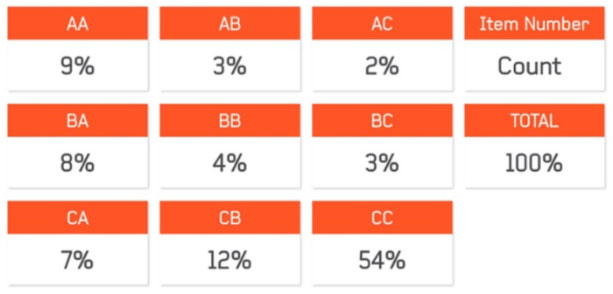
A common approach is to use a 3×3 matrix with volume value on the Y-axis and order lines on the X-axis, creating a “double” ABC classification. Typically, 80% of the volume value is assigned to A items, 15% to B items, and 5% to C items. The same 80/15/5 breakdown applies to the number of order lines. A few high-volume value items usually hit the 80% threshold of the AA category quickly, leaving most items in the CC category.

Example of ABC classification.

Service levels are then assigned to each ABC class through a “trial-and-error” process. The AA class typically gets the highest service level targets, and the CC class gets the lowest. 

If the aggregated service level doesn’t meet the company’s overall target, say, 95.0%, adjustments are made to the service level targets per class. Once the settings are in line with, or slightly above, the company´s overall target, 95.5% in this example, the process stops. 

Now every item in each ABC class shares the same service level target. For example, if there are 10,000 stocked items in a location, all 5,400 items (54% from the ABC classification example above) in the CC class will have the same target. Safety stock levels can then be calculated.

The drawbacks of ABC classification

Now, let us pause and think for a moment.

The stock investment depends on the service levels set for each ABC class. Could other service level combinations achieve the same 95.5% result? Absolutely. There are countless combinations that could give the same 95.5% overall service level, all with different stock investments.

So, how do we know if our chosen assignment of service level per ABC class is optimal? We don’t. That’s why we call it inventory management – not inventory optimization.

The example above describes one level, but supply chains are often more complex, with multiple levels/tiers (central, regional, and local warehouses). Some traditional inventory management software uses an 8×8 ABC matrix for each location. With many locations, setting up and maintaining this system can become a very labor-intensive task. And we still can’t be sure if we have the optimal set-up.

Why inventory optimization beats traditional inventory management

So, is there a better way to segment items, assign service level targets, and optimize safety stock levels today? Yes, there is.

While traditional ABC classification focuses on operational logistics, often ignoring sales, marketing, and customer needs, inventory optimization looks at the product range and the business.

This modern approach uses Service Classes, for example, “Accessories”, “High-margin products”, “own-brands”, and “Critical spare parts”. This categorization is more relevant to sales and marketing, who might not even understand ABC classification.

Stock-to-service for better inventory management

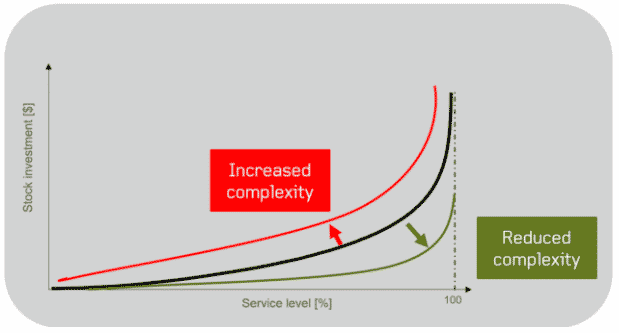
In inventory optimization, you set service level targets per service class, not ABC class. The software optimizes each Item-Location’s service level and safety stock level using a “stock-to-service” curve. This ensures that you meet the aggregated service class target but with minimal stock investment. Let´s think about this. Using the ABC approach, all items in a class are assigned the same service level as an input. In inventory optimization, the software optimizes the individual Item-Location service level, this is an output,

Schematic Stock-to-Service curve (Efficient frontier).

This automated differentiation of service levels (known as mix optimization) within each service class, considering lower bounds, is an outstanding way to reduce stock investment and increase service level at the same time. For example, “Accessories” might have an overall target of 93%, with a lower bound of 90%. The software then assigns service levels between 90% and 99.99% in such a way that the service class still reaches 93% as a group but with minimum stock investment, i.e. optimization. Similarly, “Critical spare parts” may target 99.5%, with a lower bound of 99.0%, still giving the system some level of freedom in the mix optimization step.

The result? Each item in each location is optimized individually but in relation to all other items in the same service class and in relation to upstream and downstream locations (known as Multi-Echelon Inventory Optimization, MEIO). Actually, they compete about the stock investment among each other you could say. In inventory management, items are treated as isolated entities. Inventory optimization software models tens of variables such as demand variability, standard cost, order quantity, lead time, lead time variability and more – unmanageable with the traditional approach.

Modern inventory optimization automates the planning of complex supply chains with hundreds of thousands of Item-Location combinations, guaranteeing service levels with minimum stock investment. This is all done with a very limited number of planners.

Ready to upgrade your inventory management?

Are you still relying on old inventory management methods? Transform your inventory strategy today with cutting-edge inventory optimization tools. Say goodbye to outdated ABC classification and hello to smart, efficient, and cost-effective inventory optimization.

Get started with inventory optimization today!

Contact us to book a meeting

By clicking “Submit”, I agree to Optilons privacy policy.