


When planners and decision-makers work from different information, things fall through the cracks. Optilon Collaboration brings them together around a single, real-time view of demand, supply, and inventory. We spoke with Caroline Svensson, Senior Supply Chain Consultant, and Emma Rosén, Senior Supply Chain Consultant at Optilon, about the thinking behind it.
What customer challenge triggered the development of Optilon Collaboration?
– It was actually the realization that many customers face similar challenges but are at different stages in addressing them. A common gap is the disconnect between detailed planners and those with market insight or strategic decision-making authority. We wanted to bridge this by creating a collaborative platform that connects the organisation around a shared view of planning data—giving decision-makers access to actionable supply chain insights.
What can users do today with Optilon Collaboration that they couldn’t do before? What is the biggest change in their day-to-day work?
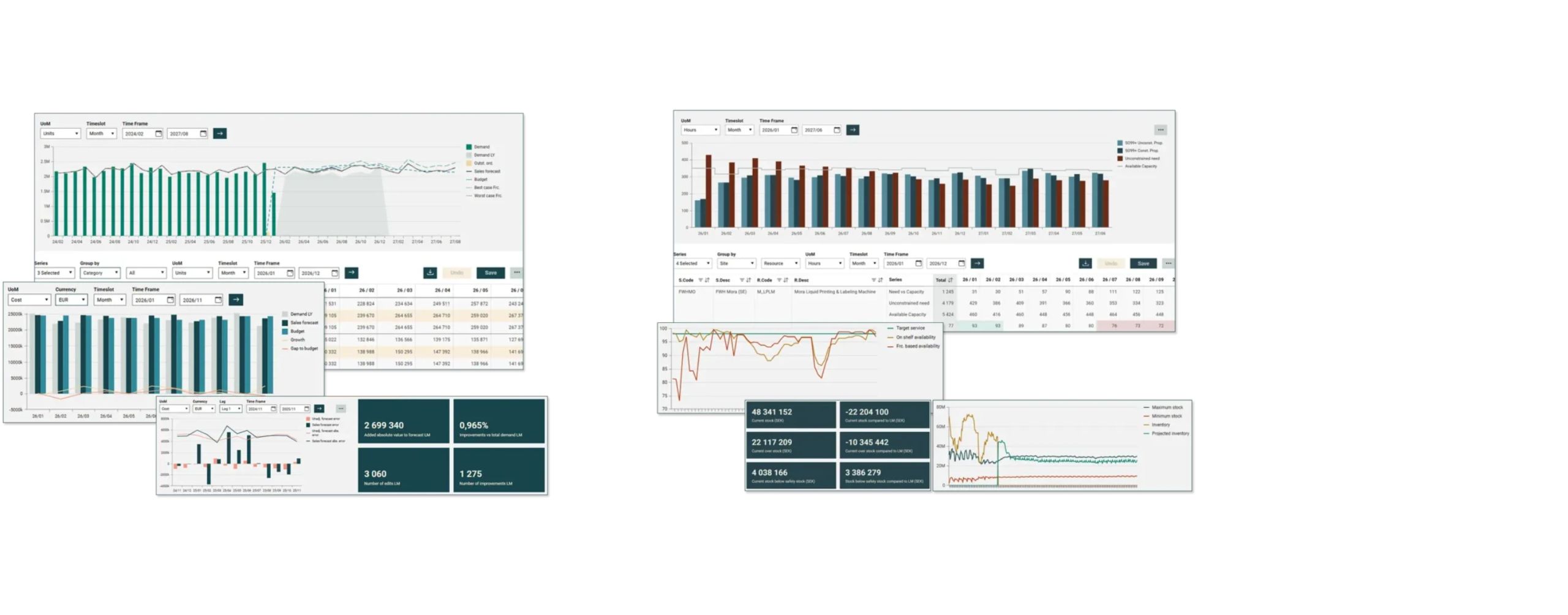
– Users now have access to an up-to-date, unified view of both demand and supply—sales forecasts, market trends, growth targets, supply plan, inventory and service —all in one intuitive platform. This enables roles across the organisation to act proactively: sales teams can contribute to forecasts and track targets, while operations teams can plan capacity, investments, and identify risks earlier. For supply chain managers, this level of visibility should be standard—but without a collaborative interface, it often isn’t.
Who typically uses the platform and how do different roles collaborate in it?
– The platform is designed primarily for stakeholders who previously lacked access to detailed planning data. Rather than adding another tool for planners, it empowers decision-makers one level up with the same insights. This ensures alignment between planning and decision-making, making actions more realistic and executable.
What are the most important capabilities of Optilon Collaboration and why do they matter for customers?
– Ease of use and configurability are key. The platform is intuitive even for infrequent users and can be adapted to each customer’s level of maturity.
This supports a scalable journey—from collaborative demand planning to S&OE, S&OP, and ultimately a fully integrated IBP process.
Have any customers already tested or piloted the platform, and if so, what has their feedback been?
– Yes, since launching the demand planning capabilities a little more than a year ago, 10–15 customers have adopted the platform. Feedback has been very positive, particularly regarding usability, performance improvements, and configurability. Following the launch of supply planning functionality at the end of 2025, making the platform more complete, interest has expanded even more and two customers are already actively evolving their S&OP processes using Optilon Collaboration.
How do you see Optilon Collaboration evolving over the next twelve months?
– Our primary focus is continuous improvement based on customer feedback—ensuring the platform delivers real value to our users. We are also prioritizing enhanced inventory management capabilities, including support for stock decisions, and expanding scenario planning to help customers build resilience in an increasingly complex planning landscape.
Want to learn more?
With 20+ years of experience and more than 1,000 successful projects, Optilon helps companies design supply chains that work – and keep improving.
Book a meeting with a supply chain expert to explore how Optilon Collaboration can help your business make better decisions.