


From reactive operations to proactive resilience
Supply chains face constant shifts in demand and cost.
Many companies still rely on disconnected tools and limited visibility.
AI-driven optimization brings planning together. It helps organizations move from reactive firefighting to proactive decisions.
A supply chain digital twin for one unified view
Data often sits in separate systems, making it hard to get a consistent view. Our Supply Chain Digital Twin creates a single source of truth across demand, supply, inventory, capacity, and transportation data, improving consistency and speeding up scenario analysis.
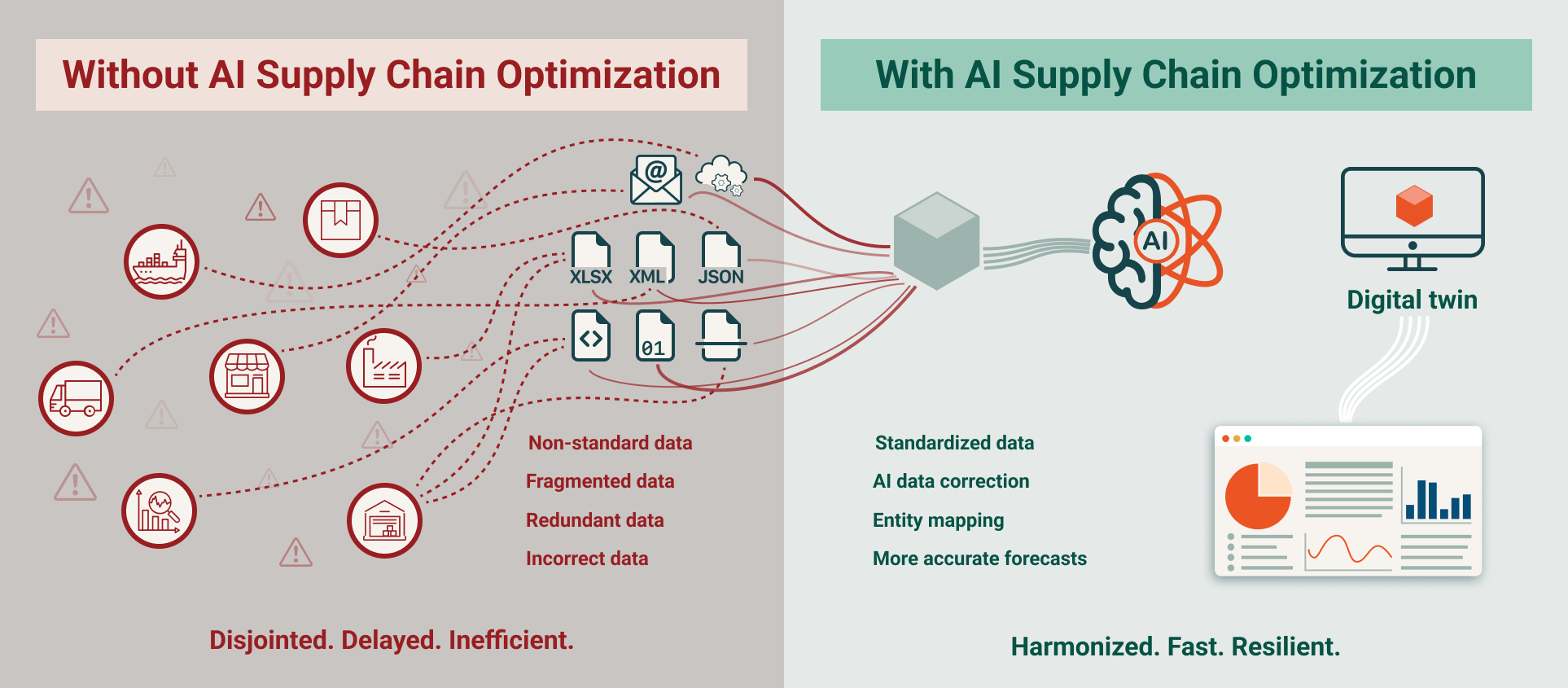
This creates harmonized planning assumptions, faster and more reliable scenario cycles, and clearer trade-offs between cost and service.
KPIs influenced:
- 15 to 30 percent faster scenario cycle times through unified modeling
- Fewer alignment loops across planning teams
Smarter forecasting and optimization
AI selects the best forecast model for each product and region. Optimization evaluates trade-offs between cost, service, risk, and sustainability across network and inventory strategies.
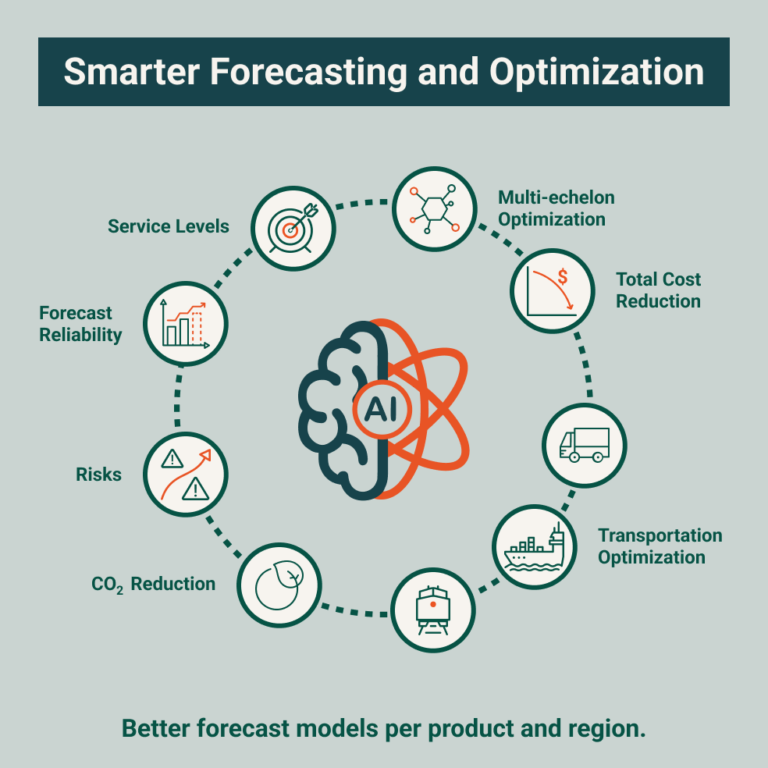
The system selects the best forecast model for each product and region, supports multi-echelon and network optimization, and enables routing across road, rail, air, and ocean.
KPIs influenced:
- Improved forecast reliability, enabling better upstream and downstream planning
- Lower total cost through optimized routing and inventory
- Higher service levels from scenario-verified strategies
High performance solving
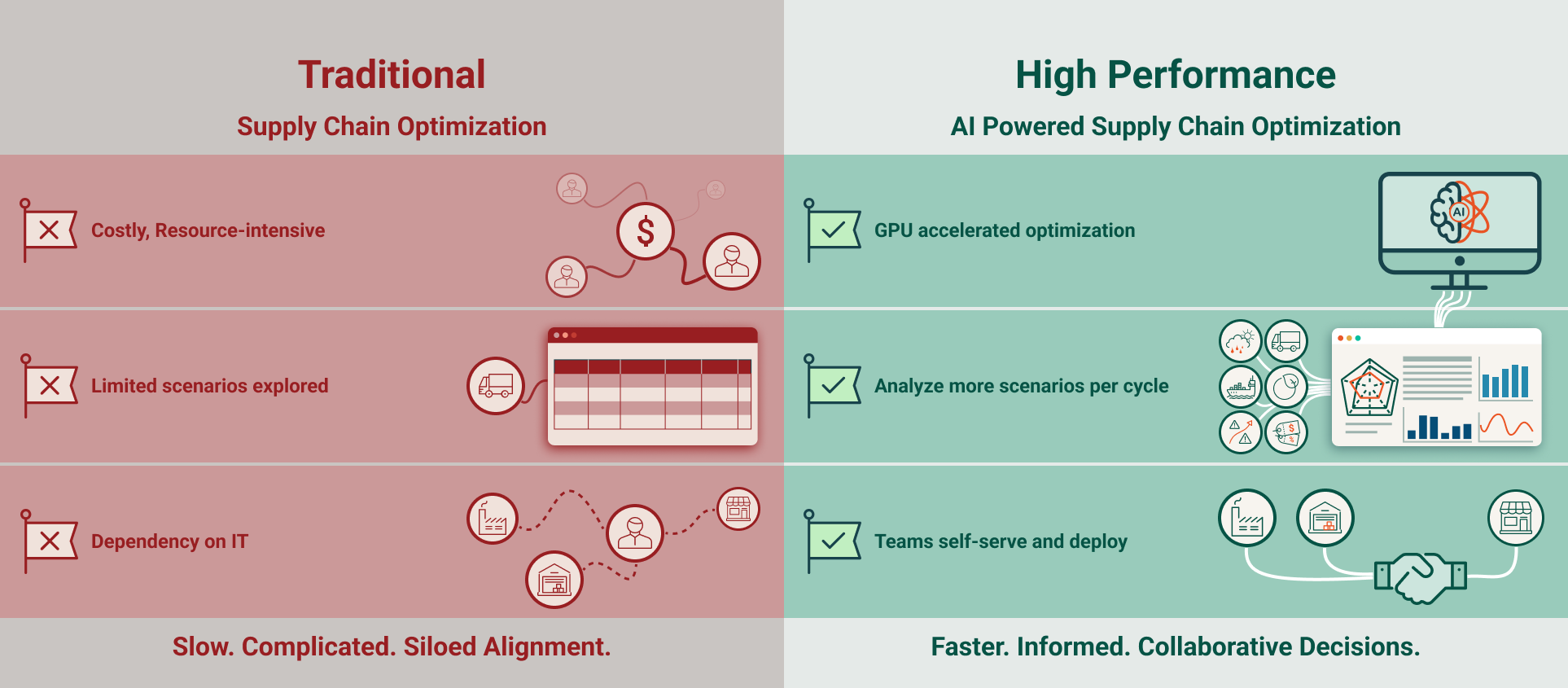
GPU-accelerated optimization makes it possible to run larger and more complex models faster. Giving organizations the ability to explore more alternatives.
KPIs influenced:
- Order-of-magnitude speed increases in large scale optimization (aligned with GPU acceleration referenced)
- More scenarios per cycle, improving strategic resilience
Interfaces built for business users
Planners can simulate changes and immediately see the impact on service, cost, lead time, and emissions. This reduces dependency on technical experts and speeds internal alignment.
KPIs influenced:
- Shorter decision lead times, because teams can self-serve
- Faster cross-functional alignment around scenario outcomes
Enterprise decision readiness
Human-in-the-loop workflows let teams test logic, run scenarios, and deploy decisions without IT. This strengthens cross-functional collaboration and supports continuous planning.
KPIs influenced:
- Reduced IT dependency, speeding execution
- Higher deployment success, since decisions are validated collaboratively
Want to learn more?
With 20+ years of experience and more than 1,000 successful projects, Optilon helps companies design supply chains that work – and keep improving.
Book a meeting with us to contact us to explore how Optilon’s AI-driven optimization solutions can support your planning and decision-making.