


Stop planning monthly in a daily market
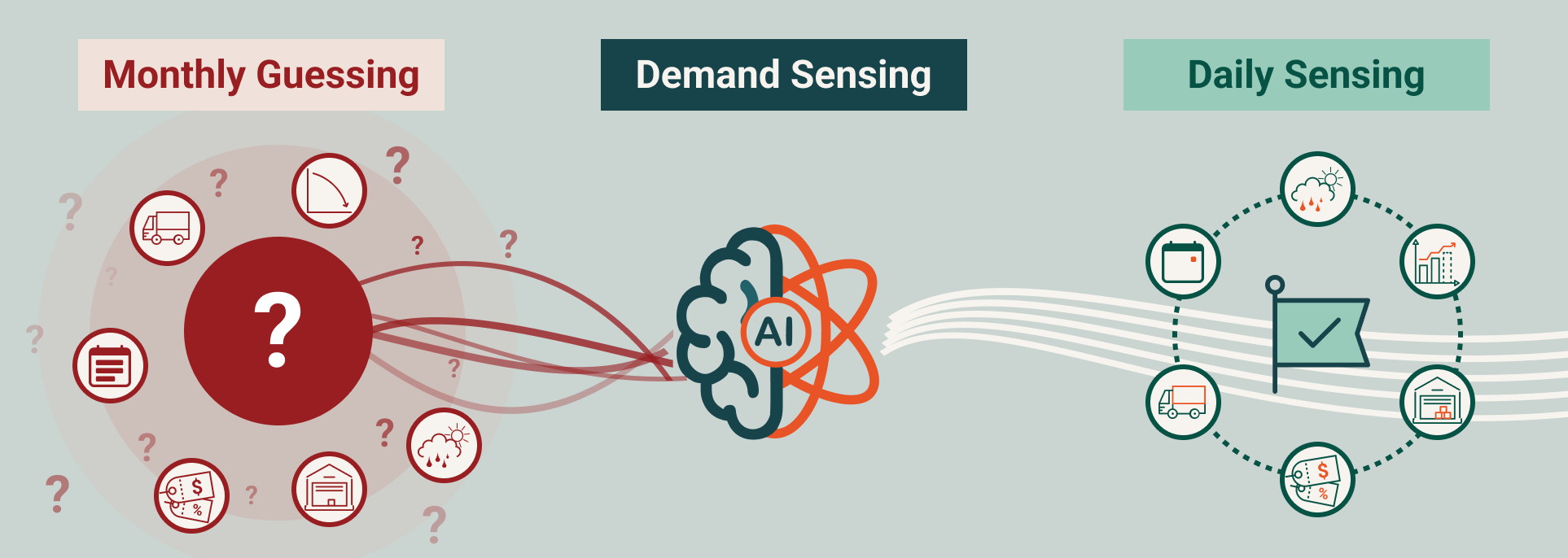
Most supply chains still plan in monthly cycles. The market moves daily. Point-of-sale data shifts. Promotions change demand patterns.
Weather alters buying behavior, and pricing decisions trigger sudden volume swings. Without continuous sensing, planning becomes educated guessing. Small demand changes go unnoticed until they become shortages or excess inventory.
Demand sensing addresses this gap by continuously analyzing downstream demand signals. Instead of reacting weeks later, companies can respond immediately.
From reactive corrections to continuous control
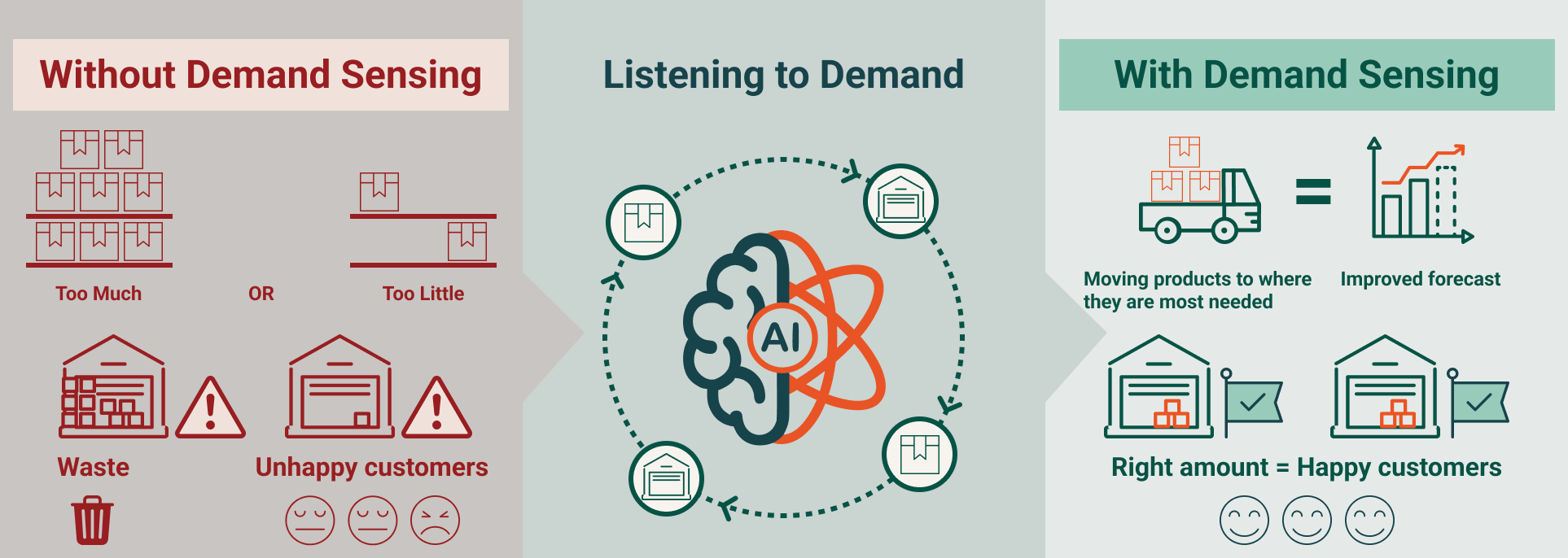
Traditional forecasting approaches rely on periodic updates. This creates latency between what is actually happening in the market and what the supply chain believes is happening.
Without demand sensing:
- Inventory imbalances across locations
- Unexpected stockouts or overstocks
- Increasing waste and working capital pressure
- Firefighting planners and reactive decisions
Turning demand signals into action
With demand sensing in place, companies move from reactive corrections to proactive control.
Demand signals are captured daily and analyzed using machine learning to identify meaningful deviations. The system evaluates the impact and recommends corrective actions.
Key downstream signals typically include:
- Point-of-sale transactions
- Promotions and marketing activities
- Price changes
- Weather patterns
- Seasonal and local demand drivers
This is not just a forecast update. It is continuous demand control that keeps planning aligned with real market behavior.
Improving both forecast accuracy and inventory decisions
Improved forecasting is only part of the value. Demand sensing also improves inventory decisions across the network.
As signals change, inventory can be dynamically rebalanced. If demand accelerates in one region while softening in another, the system recommends redeployment actions to protect service where it is at risk and reduce excess where it is building.
By reducing the gap between shelf reality and planning assumptions, organizations gain valuable time to adjust production, deployment, and transportation decisions — before small deviations become costly disruptions.
Measurable performance gains — without adding work
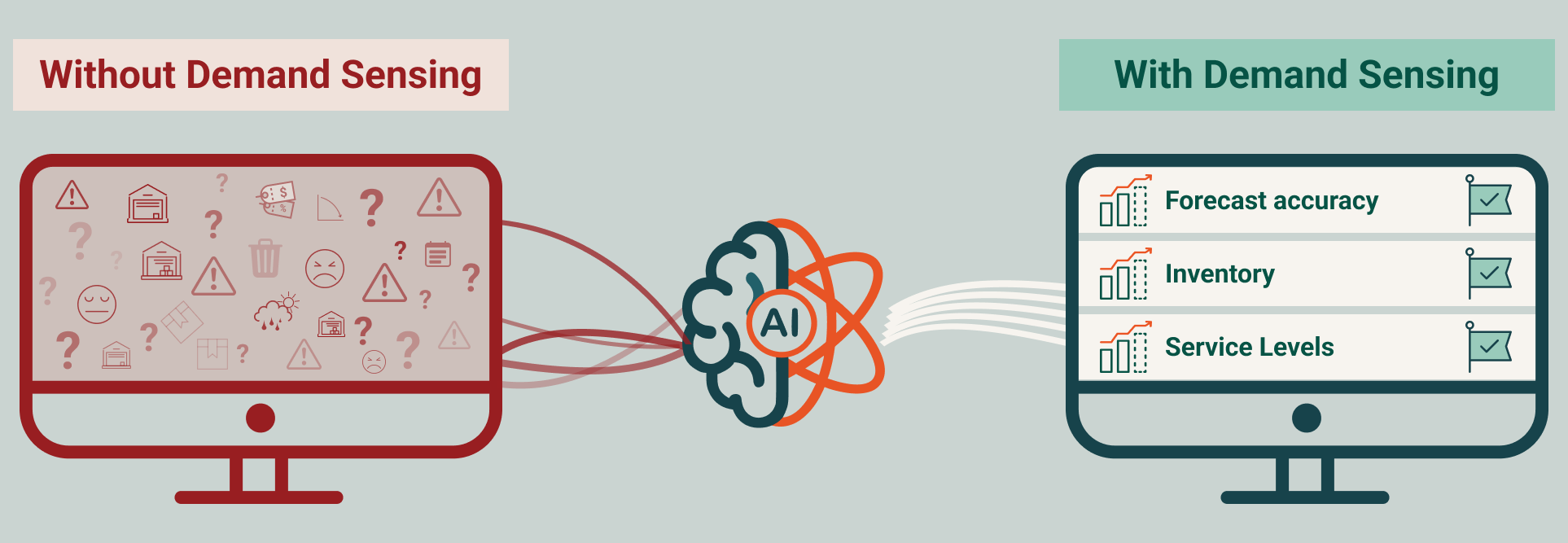
Demand sensing delivers results that matter to both planners and executives:
- 15–40% improvement in short-term forecast accuracy
- 10–30% reduction in inventory
- 2–5 percentage-point service-level increase
The system continuously ingests fresh demand data, detects what matters, and escalates only what requires attention. Planners work by exception, focusing on the few items or locations that truly matter.
No spreadsheet overload. No manual re-forecasting cycles.
Just clearer decisions.
A core capability of the AI-first control layer
Demand sensing delivers the greatest value when implemented as part of a broader decision architecture.
When combined with probabilistic planning and multi-echelon optimization:
- Near-term signals become more accurate
- Structural buffers across the network are optimized
- Service improves
- Working capital decreases
This shift represents a move from static planning cycles toward continuous decision orchestration where supply chains operate with greater speed and precision.
Want to learn more?
With 20 + years of experience and more than 1,000 successful projects, Optilon helps companies design supply chains that work – and keep improving.
Book a meeting with a supply chain expert to explore how Optilon’s AI-powered demand sensing solutions can help you respond faster to market signals, improve forecast accuracy, and keep inventory aligned with real demand.