Accurate forecasting depends on understanding what demand truly represents. 
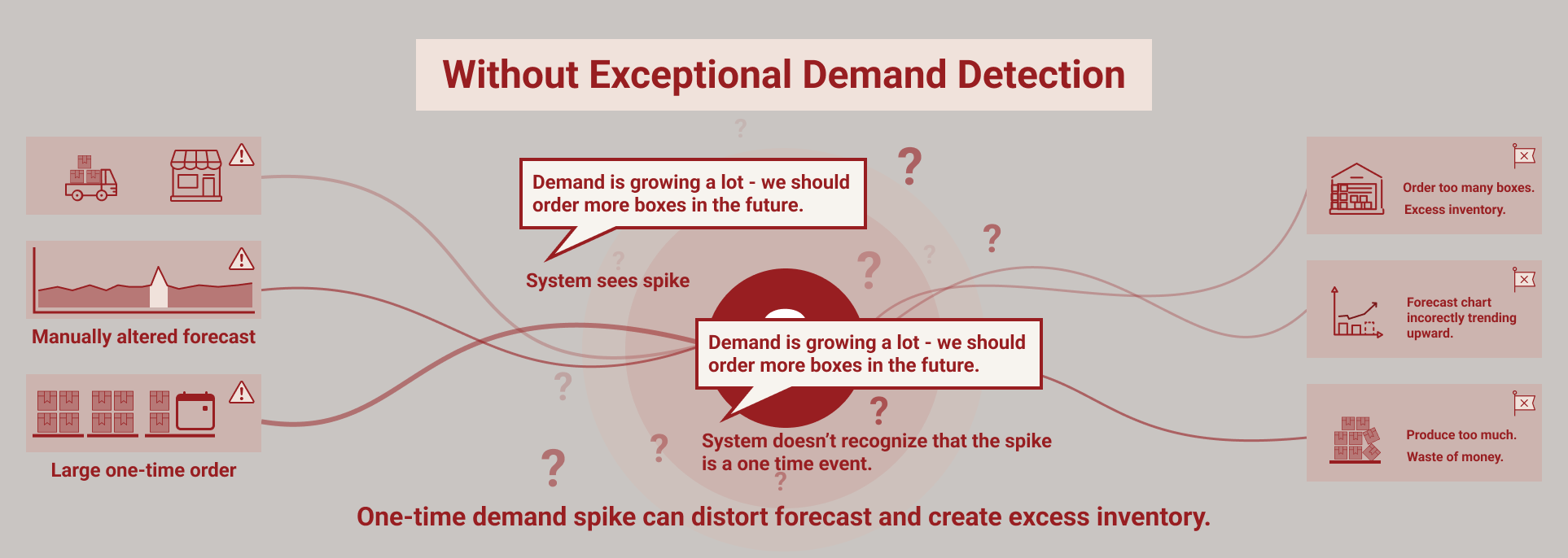
Yet in most supply chains, demand data contains temporary spikes, exceptional orders, and oneoff events that do not reflect normal buying behavior. When these anomalies are not handled correctly, they distort forecasts and introduce noise into planning decisions. 

As product portfolios grow and demand becomes more volatile, manual review of these exceptions becomes increasingly difficult. 

Why exceptional demand is hard to manage 

Onetime events can come from many sources: project orders, promotions, panic buying, or shortlived customer behavior. In traditional planning environments, identifying these outliers often depends on individual planners manually reviewing demand history and deciding what should influence the forecast. 

This approach does not scale. Decisions become inconsistent, subjective, and timeconsuming. Some anomalies slip through unnoticed, while others are handled differently across products, customers, and regions. 
From manual review to automated anomaly detection 

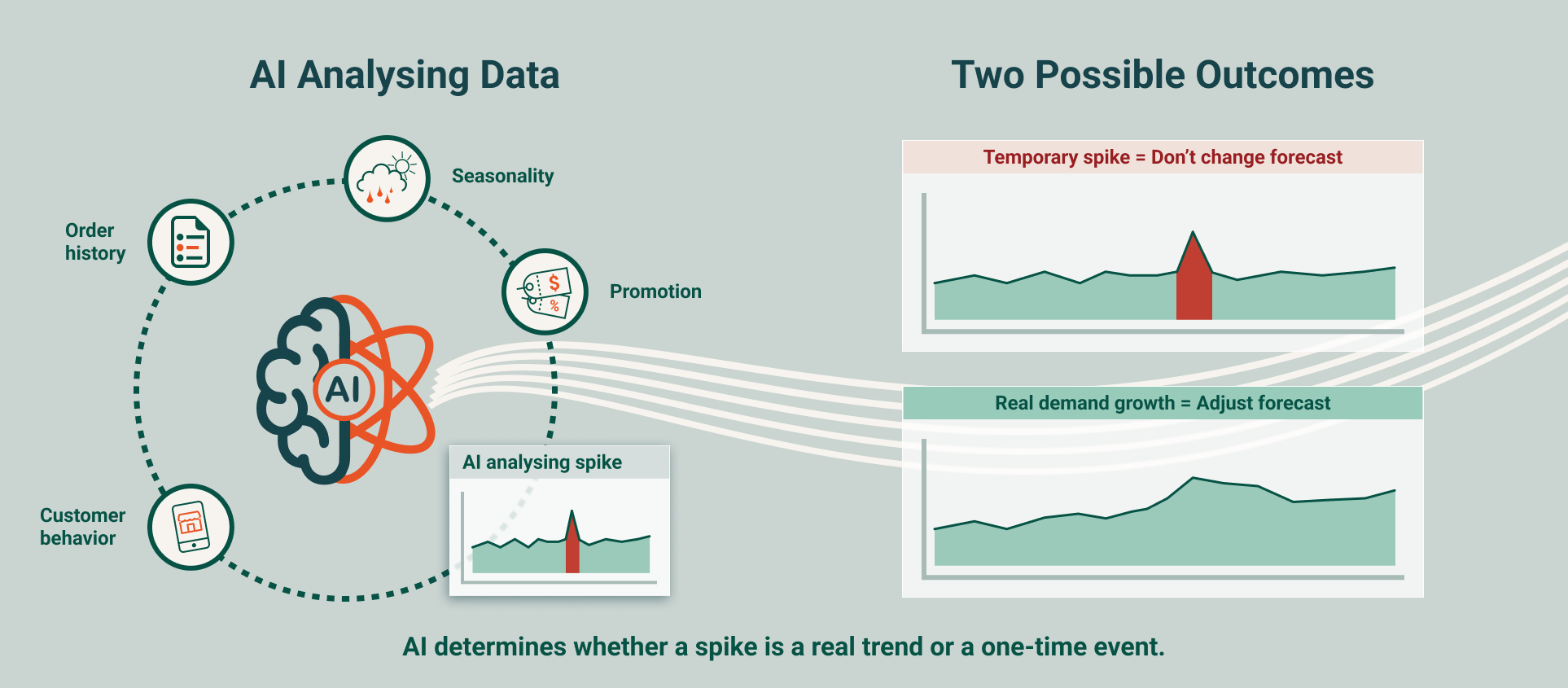
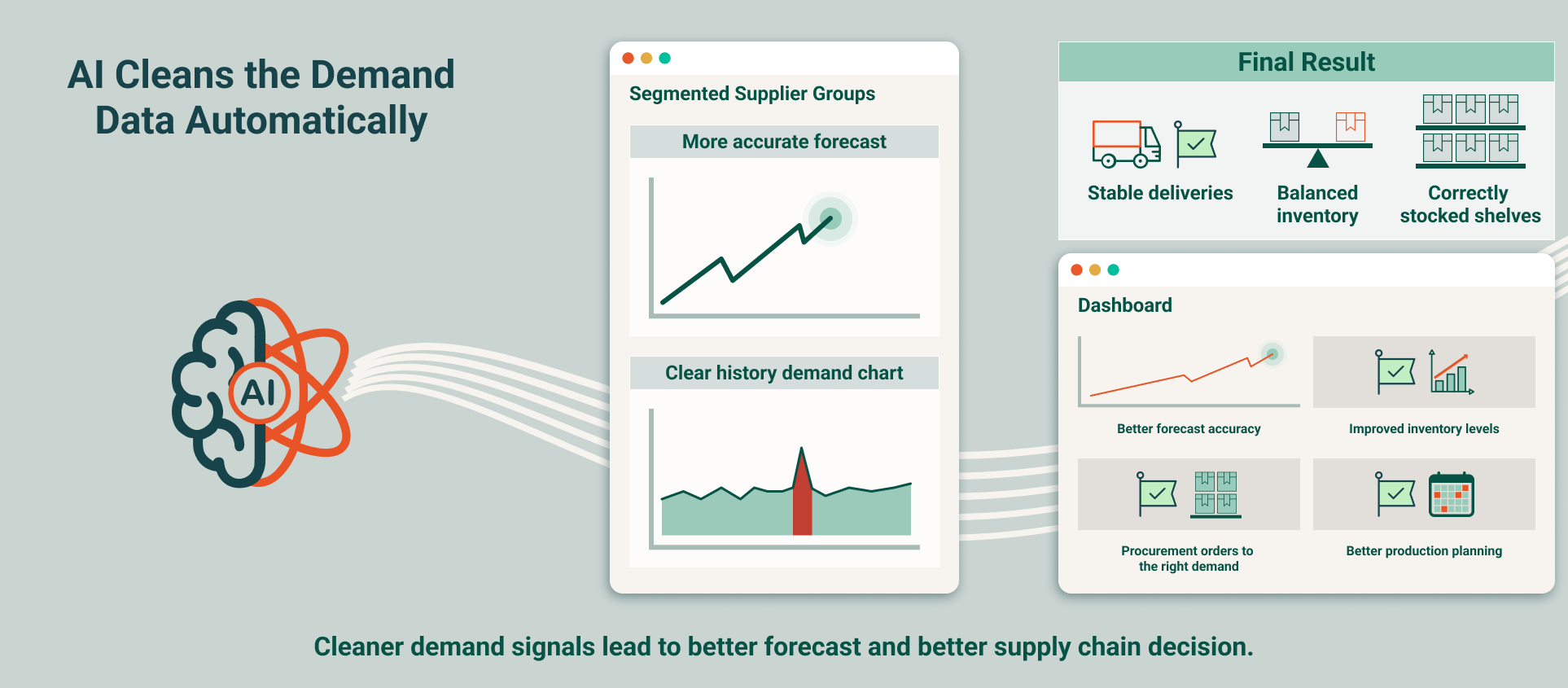
AIdriven exceptional demand detection introduces an automated layer that continuously evaluates demand behavior. Machine learning models learn what “normal” looks like for each product and customer by analyzing historical patterns, seasonality, lifecycle effects, and buying behavior over time. 

When demand deviates meaningfully from expected patterns, the system identifies whether the change represents a genuine shift or a temporary anomaly that should not influence the baseline forecast. 


How automated detection supports planners 

  • Identifies onetime demand spikes before they distort forecasts 
  • Separates temporary anomalies from real demand changes 
  • Reduces the need for planners to manually inspect demand history 

Planners are involved only when validation or context is needed, allowing them to focus on analysis instead of data cleanup. 
Cleaner inputs lead to calmer planning 

With anomalies handled consistently, forecasting models work with cleaner and more stable input data. This improves forecast reliability and reduces the overreaction that often follows temporary demand spikes. 

Downstream processes also benefit. Inventory levels are better aligned with real demand, production schedules become more stable, and procurement avoids ordering excess materials driven by shortterm noise. The entire planning process becomes more predictable and easier to manage. 
Measurable impact 

  • Higher forecast accuracy through cleaner demand history 
  • Reduced manual workload for planners 
  • More consistent handling of demand anomalies across teams 
  • Improved inventory and production alignment 

Want to learn more?

With 20 + years of experience and more than 1,000 successful projects, Optilon helps companies design supply chains that work and keep improving.

Book a meeting with a supply chain expert to explore how predictive demand sensing can improve forecast accuracy, reduce demand uncertainty, and strengthen customer insights.
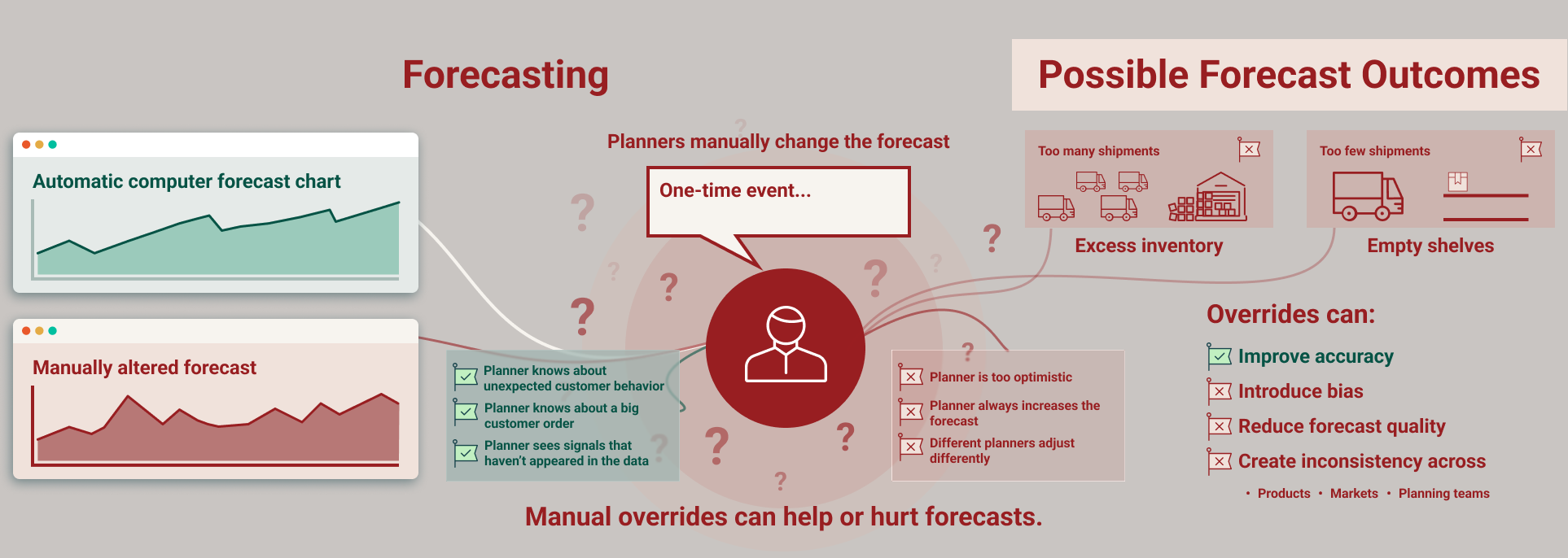
Manual forecast overrides play an important role in demand planning. Planners often have access to information that statistical models cannot yet reflect, such as customer behavior changes, oneoff events, or early market signals. When applied well, overrides add valuable context and improve forecast quality. 

The challenge is knowing when overrides truly add value — and when they quietly reduce accuracy. 

Why manual overrides are difficult to manage 

In many organizations, override decisions are made under time pressure and based on individual judgment. Once applied, they are rarely evaluated in a structured way. 

Over time, this creates several issues: 

  • Overrides accumulate without clear ownership or rationale 
  • Similar situations are handled differently across teams and regions 
  • Planners repeat adjustments without knowing if they helped last time 

Without visibility into outcomes, planning behavior becomes inconsistent and harder to govern. 

From subjective intuition to evidencebased evaluation 

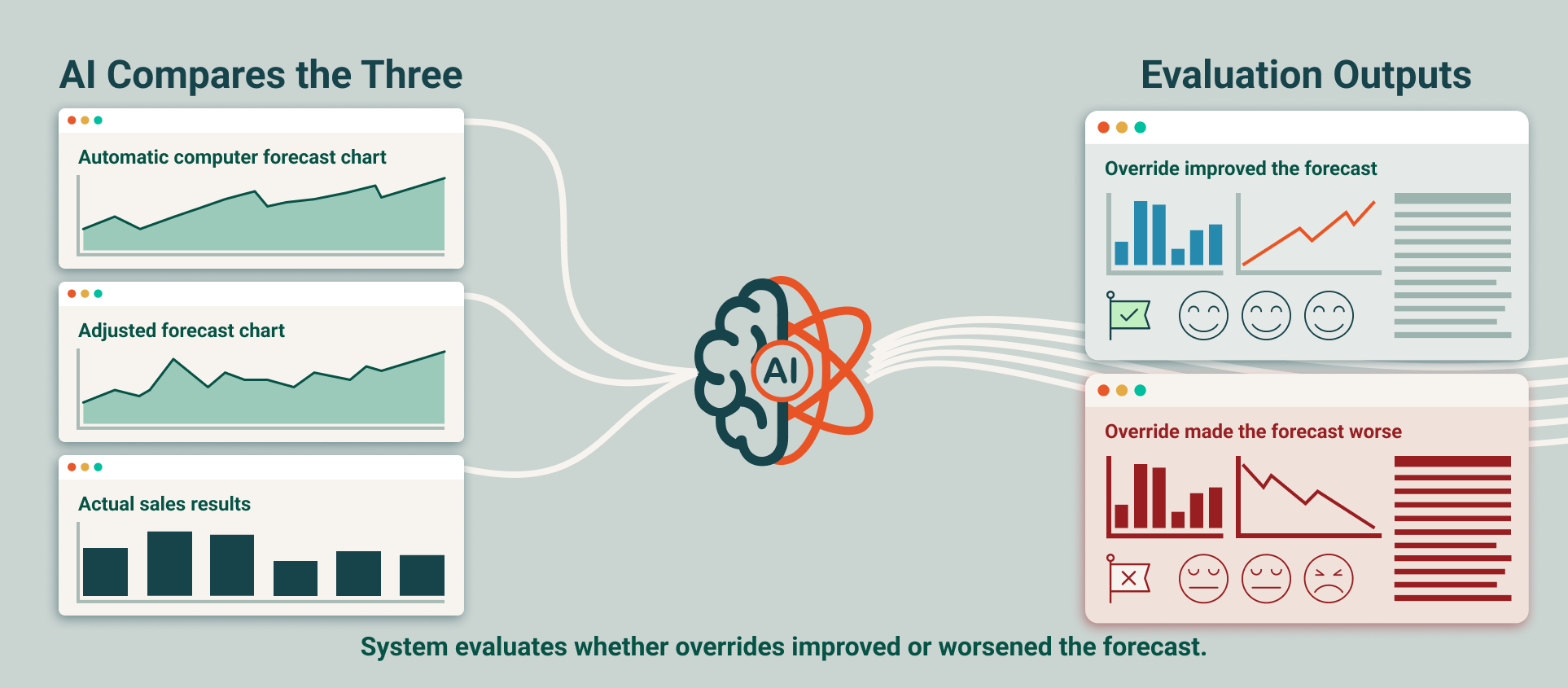
AIdriven forecast override assessment introduces an objective way to evaluate manual adjustments. The system compares the original statistical forecast, the overridden forecast, and the actual demand outcome to determine whether the adjustment improved or weakened accuracy. 

By learning from historical override patterns, the system helps teams understand when manual intervention tends to work and when it does not. 

How override assessment supports better planning 

  • Evaluates the true impact of each override instead of relying on opinion 
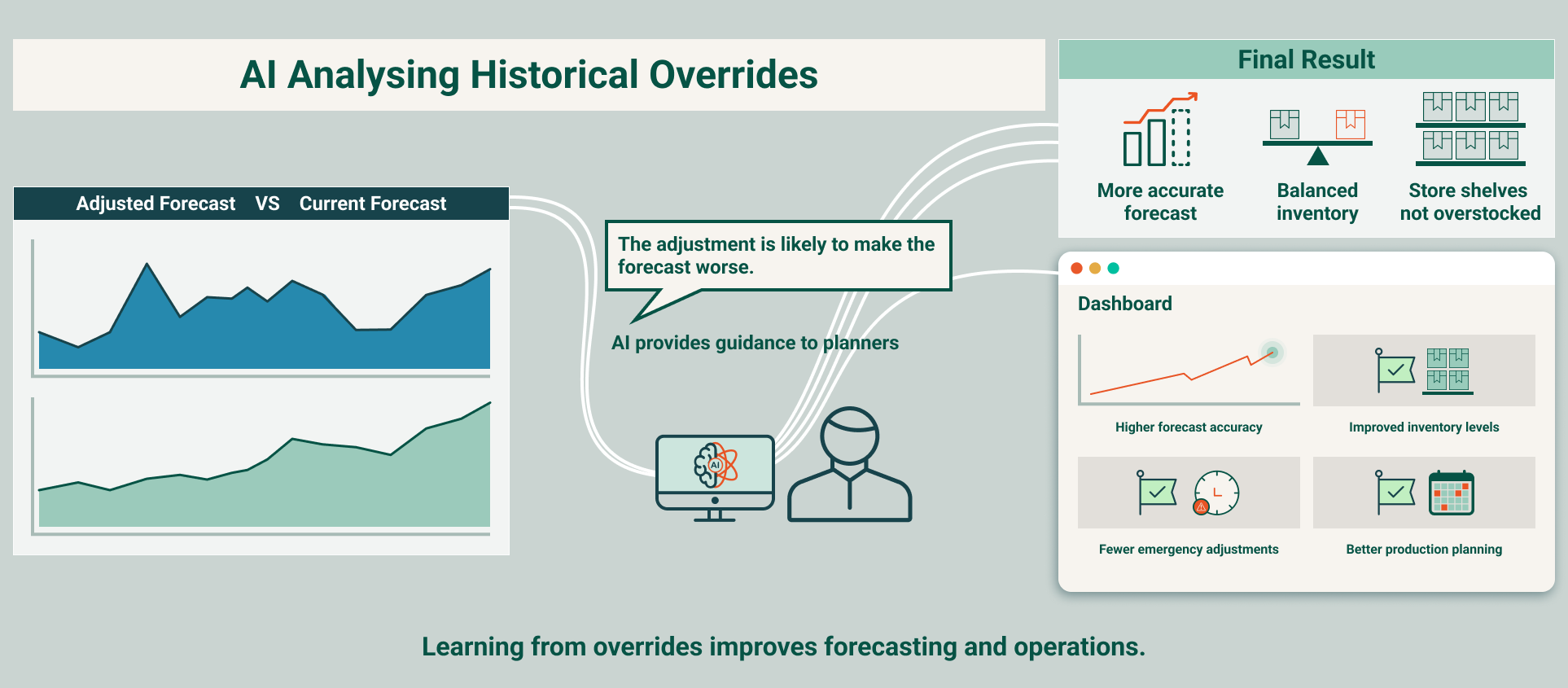
  • Explains why an override helped or harmed accuracy using historical context 
  • Provides guidance during forecast reviews, not only after results are known 

This shifts override decisions from habit and intuition toward learning and consistency. 

Embedding transparency into forecast reviews 

Override insights integrate directly into existing forecast review routines. 
Planners receive context when considering changes, helping them decide whether an adjustment is justified. Teams gain a shared language for discussing overrides, reducing debates based on personal preference. 

Leaders gain visibility into override behavior across categories, regions, and time horizons, making it easier to support targeted coaching and governance instead of blanket rules. 

Over time, forecasting evolves from a manual adjustment process into a continuously improving discipline. 

Measurable impact 

  • Higher and more consistent forecast accuracy 
  • Reduced bias in manual override behavior 
  • Improved inventory and service performance 
  • Clearer accountability and transparency across planning teams 

Want to learn more?

With 20 + years of experience and more than 1,000 successful projects, Optilon helps companies design supply chains that work and keep improving.

Book a meeting with a supply chain expert to explore how predictive demand sensing can improve forecast accuracy, reduce demand uncertainty, and strengthen customer insights.
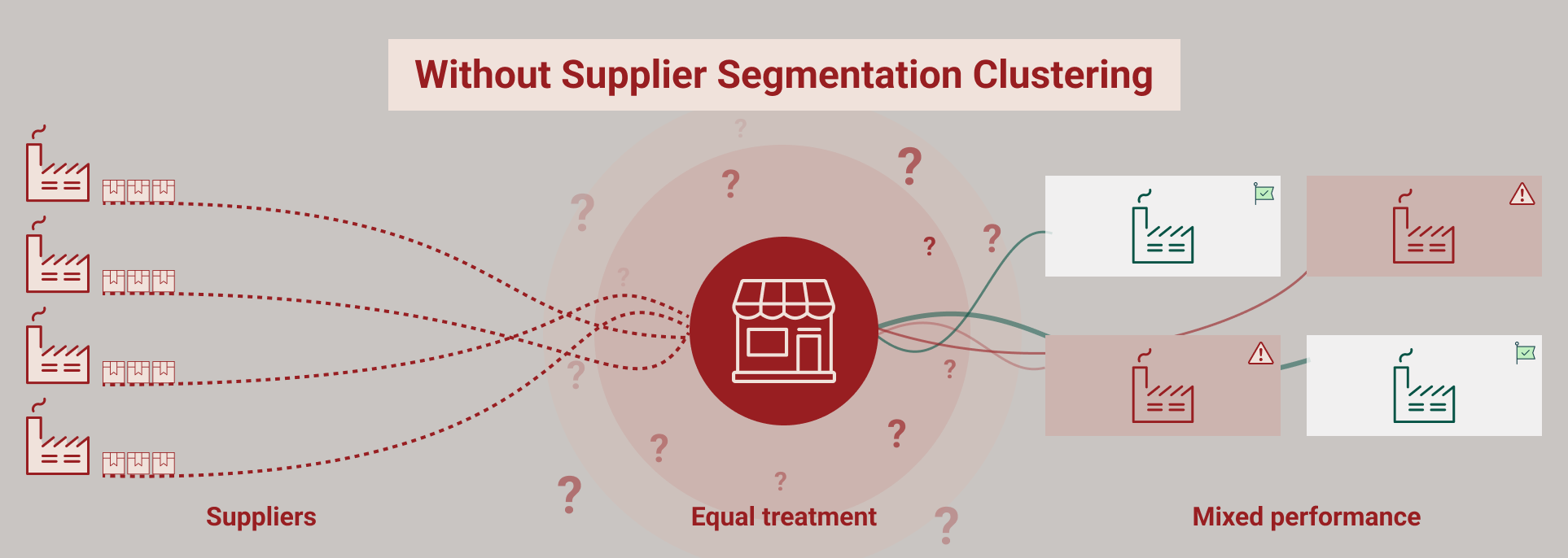
Supply chains depend on thousands of supplier relationships, yet not all suppliers play the same role. Some are critical for performance and continuity. Others contribute marginal value but consume disproportionate effort. When these differences are not visible, procurement and planning teams struggle to focus attention where it matters most. 

Many organizations still rely on static classifications or manual assessments to manage their supplier base. Over time, these approaches fall out of sync with how suppliers actually perform. 

Why onesizefitsall procurement creates blind spots 

Supplier behavior changes constantly. Delivery precision shifts. Capacity tightens. Quality drifts. External risk increases. Manual segmentation struggles to keep up with this evolution, especially as supplier networks grow larger and more complex. 

When segmentation is outdated: 

  • Critical suppliers may not receive enough attention 
  • Emerging risks remain hidden until disruptions occur 
  • Time is spent managing suppliers that have little impact on performance 

Instead of enabling better decisions, supplier data becomes fragmented and underused. 

From static classifications to datadriven clusters 

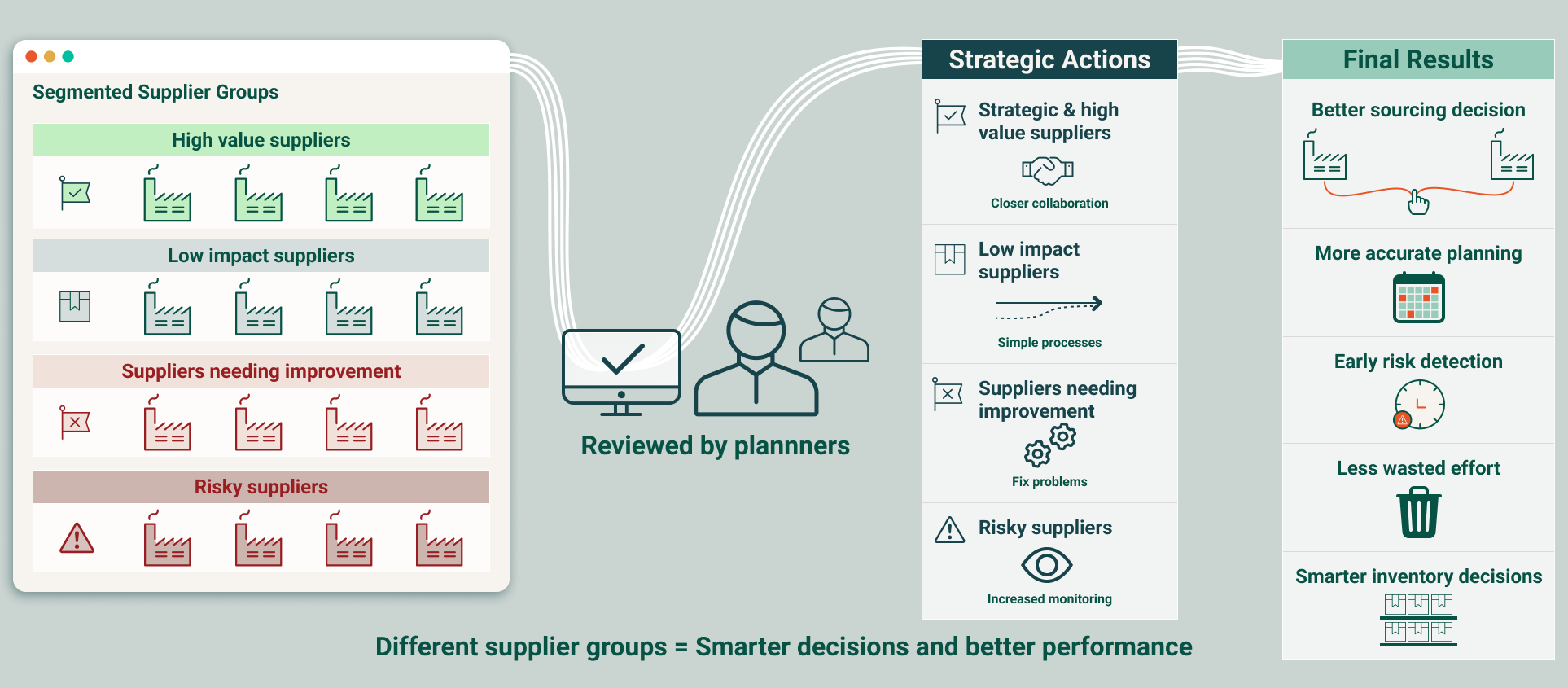
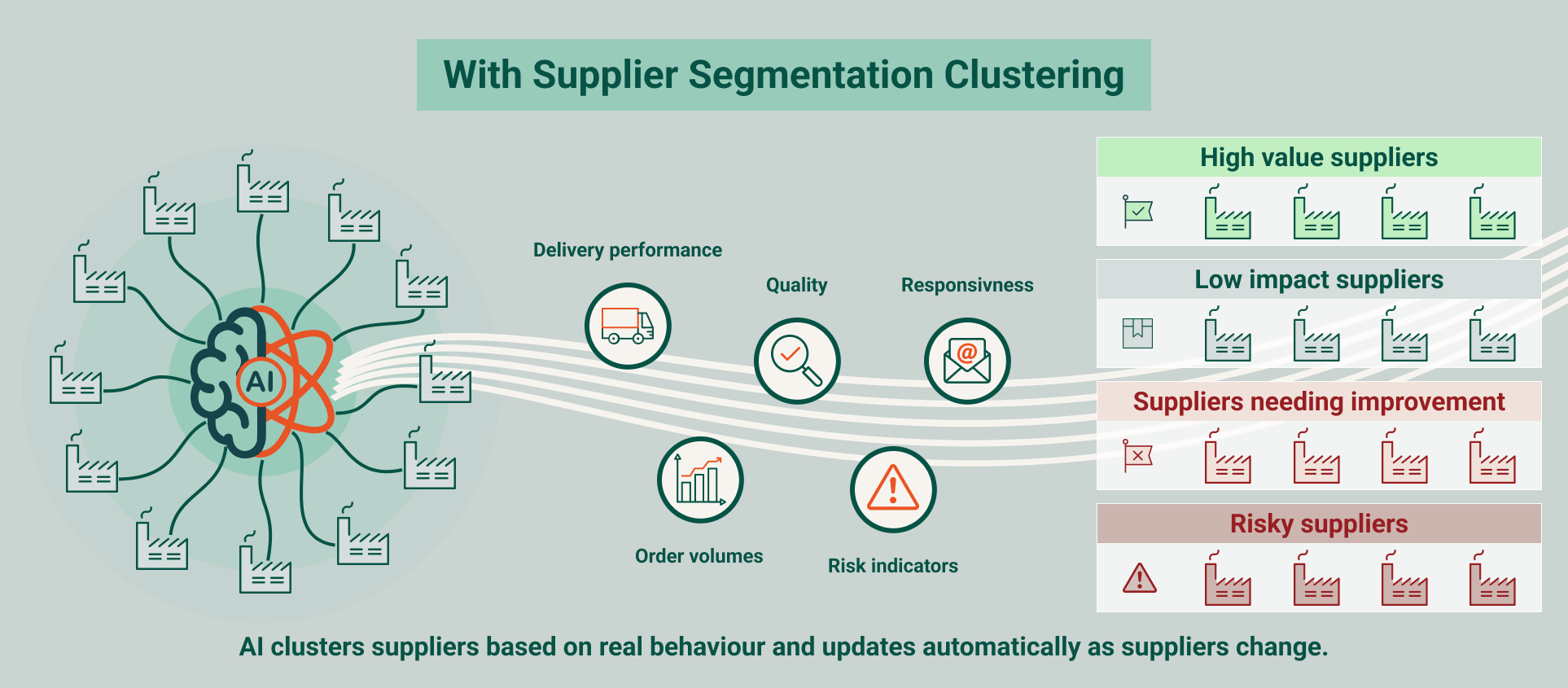
AIdriven supplier segmentation uses machine learning to identify natural groupings within the supplier base. 

Instead of applying predefined rules, the system analyzes real performance patterns and risk signals to determine how suppliers behave over time. This creates an objective, continuously updated view of supplier diversity, one that reflects reality rather than assumptions. 

How AI clustering supports daily decisions 

  • Groups suppliers based on delivery reliability, variability, quality behavior, responsiveness, and business importance 
  • Highlights segments where performance or risk is deteriorating before disruptions occur 
  • Supports differentiated strategies for collaboration, improvement, consolidation, or risk mitigation 

Procurement and planning teams gain a shared, consistent understanding of which suppliers matter most and why. 

Embedding segmentation into planning and sourcing workflows 

Supplier segments update automatically as new performance data becomes available. 
Planners can align safety stock and sourcing assumptions with the characteristics of each segment instead of applying uniform policies. Procurement teams can prioritize collaboration efforts and supplier development initiatives more effectively. 

Rather than reacting to isolated issues, organizations manage supplier performance at a structural level. 

Measurable impact 

  • More focused procurement strategies aligned to supplier behavior 
  • Improved planning accuracy through supplierspecific assumptions 
  • Earlier visibility into supplier risk trends 
  • More effective use of time and resources 

Want to learn more?

With 20 + years of experience and more than 1,000 successful projects, Optilon helps companies design supply chains that work and keep improving.

Book a meeting with a supply chain expert to explore how predictive demand sensing can improve forecast accuracy, reduce demand uncertainty, and strengthen customer insights.
AI driven production quality prediction for food and beverage

Could you predict quality issues before they reach production?

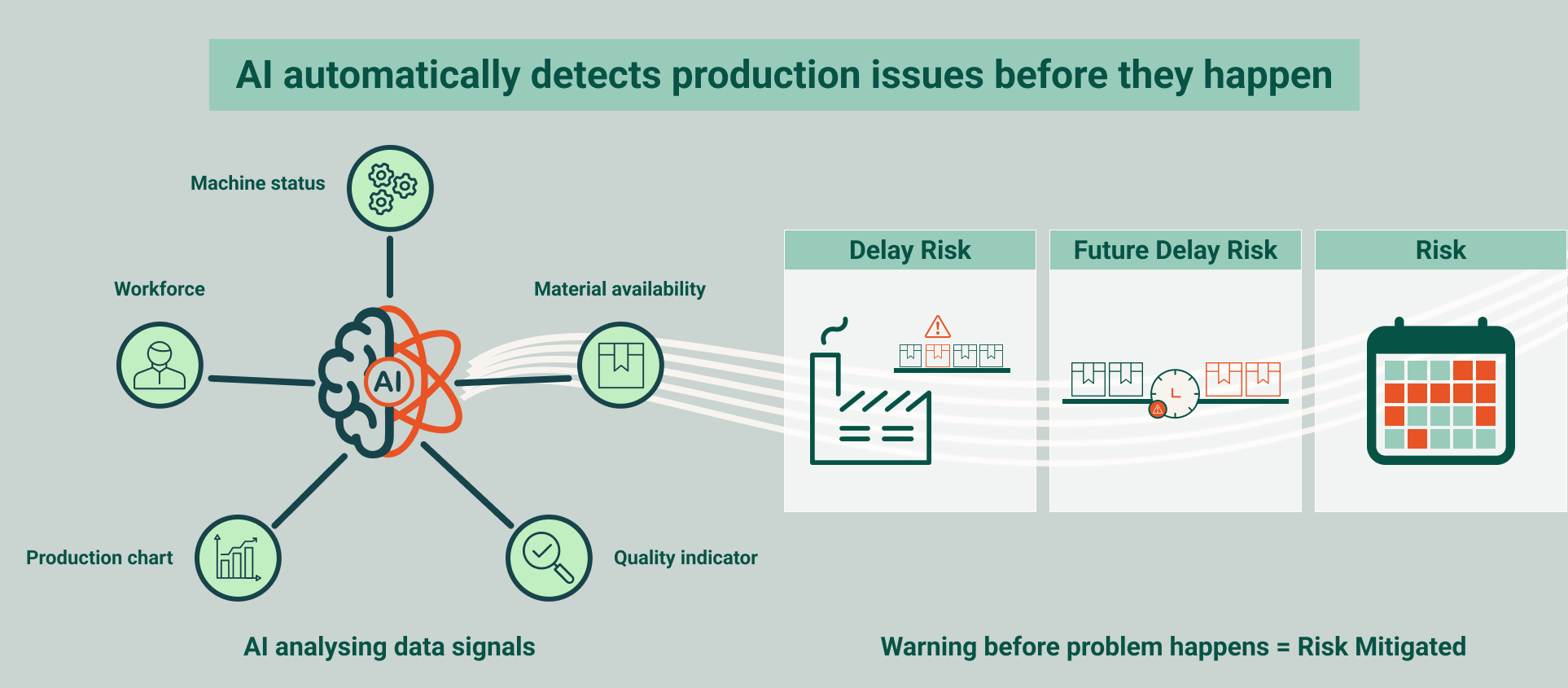
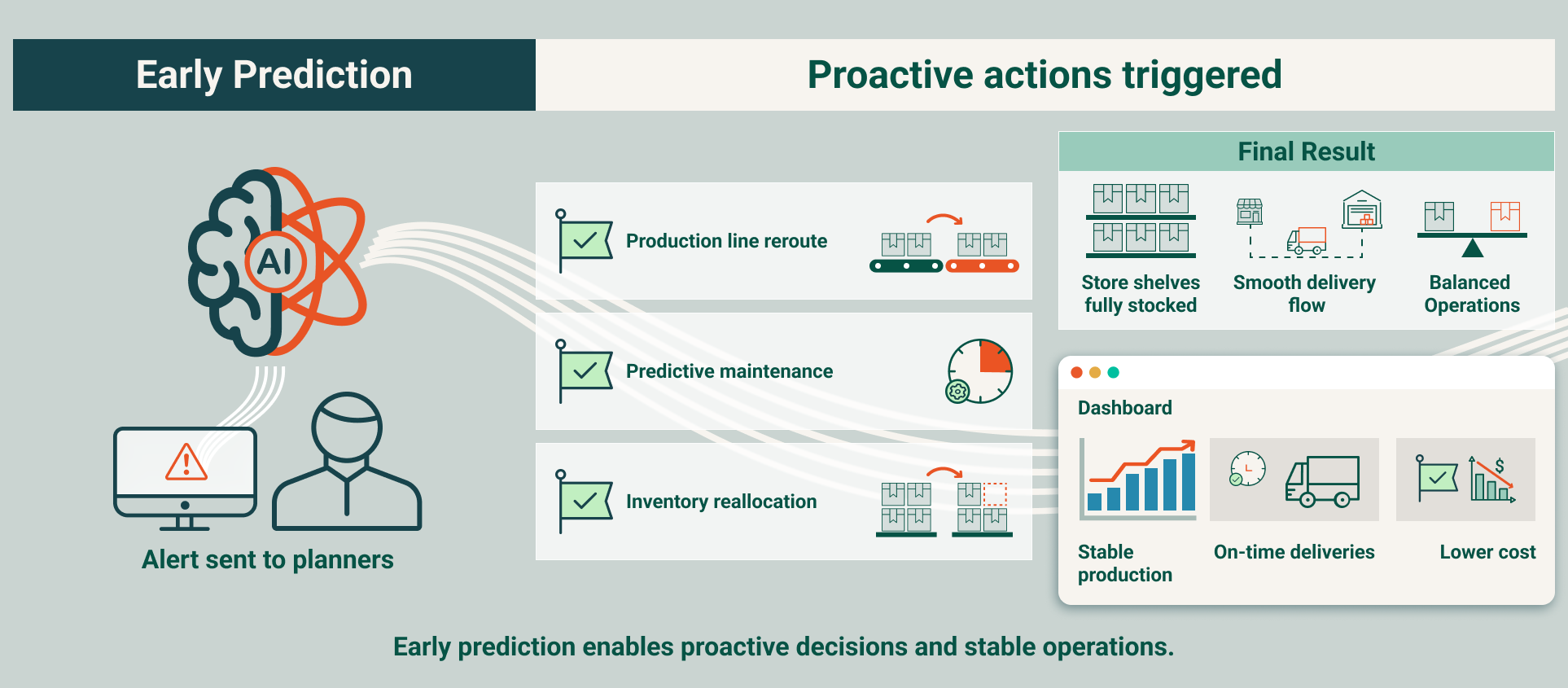
In this webinar hosted by Optilon Supply Chain Conference, Victor Bengtsson demonstrates how predictive insights into operational stability, raw material behavior, and workforce patterns help organizations move from reactive troubleshooting to proactive, stable, and cost-efficient production.

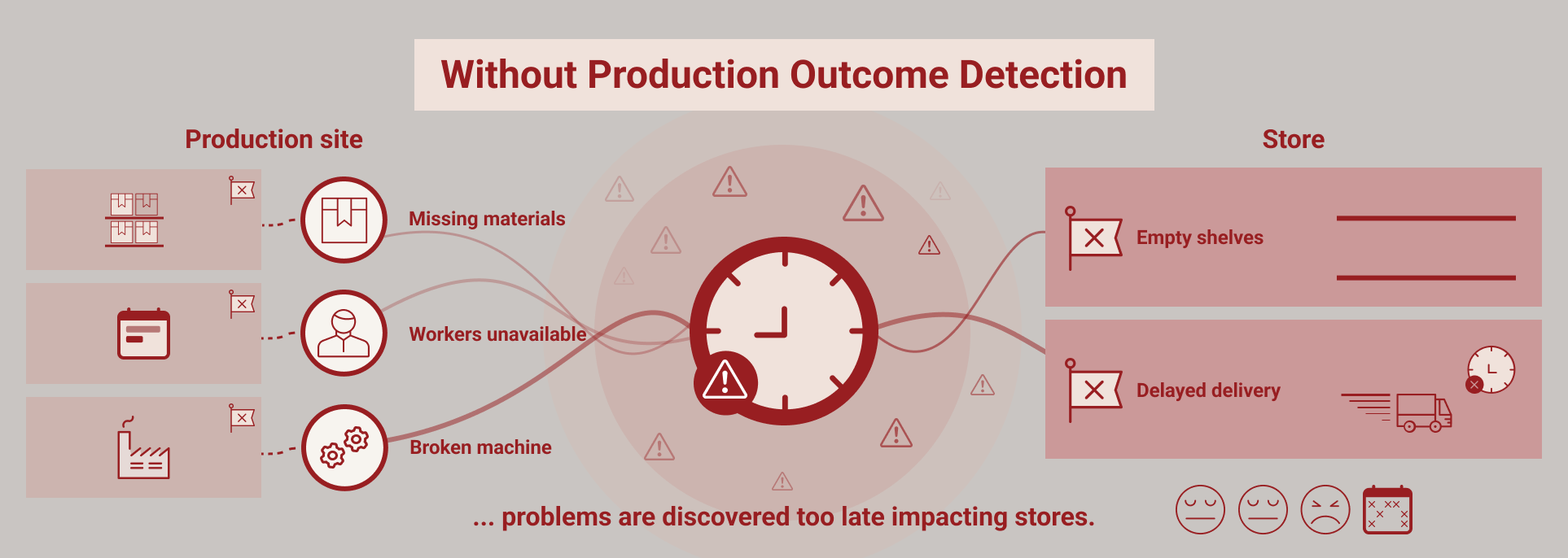
Production quality issues in production operations are often detected only after they create waste, delays, or planning instability. Predicting quality to get proactive insights, changes this by uncovering early signals of risk and giving teams the time they need to prevent quality deviations.

on demand webinar Production outcome detection

What you will learn

In this session, you will learn more about:

  • A clear understanding of which business signals have the strongest influence on production outcomes
  • Practical insight into how predictive quality monitoring supports earlier intervention and reduces operational risk
  • Tangible examples of how organizations can lower waste, prevent downtime, and improve production stability through proactive decision making

Who should watch

This session is relevant for anyone who can benefit from Production Outcome Detection, including roles focused on production quality, operational efficiency, supply chain stability, process engineering, and continuous improvement. If early detection of quality risks can help your work, this webinar is for you.

You can find our other upcoming events here!

Customer behavior rarely changes abruptly. Order patterns shift gradually. Volumes drift. Engagement weakens.

These signals often appear long before any formal change in contracts. If they go unnoticed, planning continues based on assumptions that are no longer valid.

When Contracts and Reality Diverge

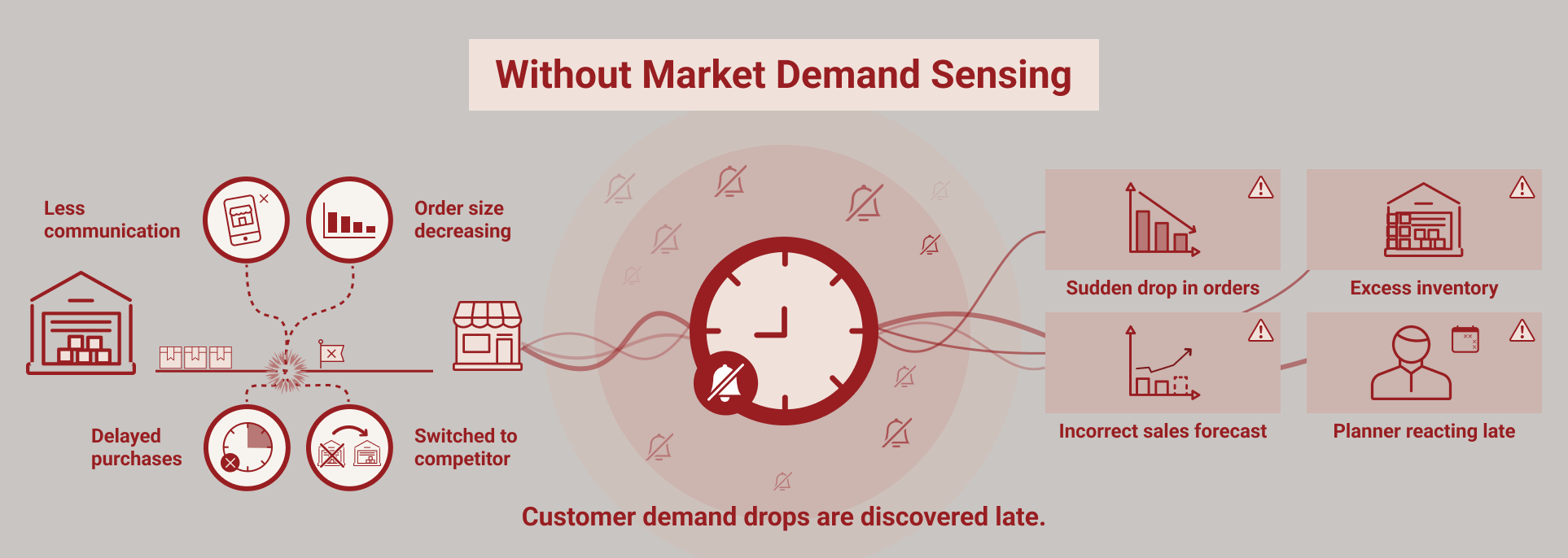
Contracts define expected demand, but actual behavior often tells a different story. Order frequency declines. Volume commitments are not fully met.

Communication slows.
Without early visibility, this gap grows, leading to excess inventory, misaligned production, and inaccurate forecasts.

market demand sensing

A Predictive View of Customer Behavior

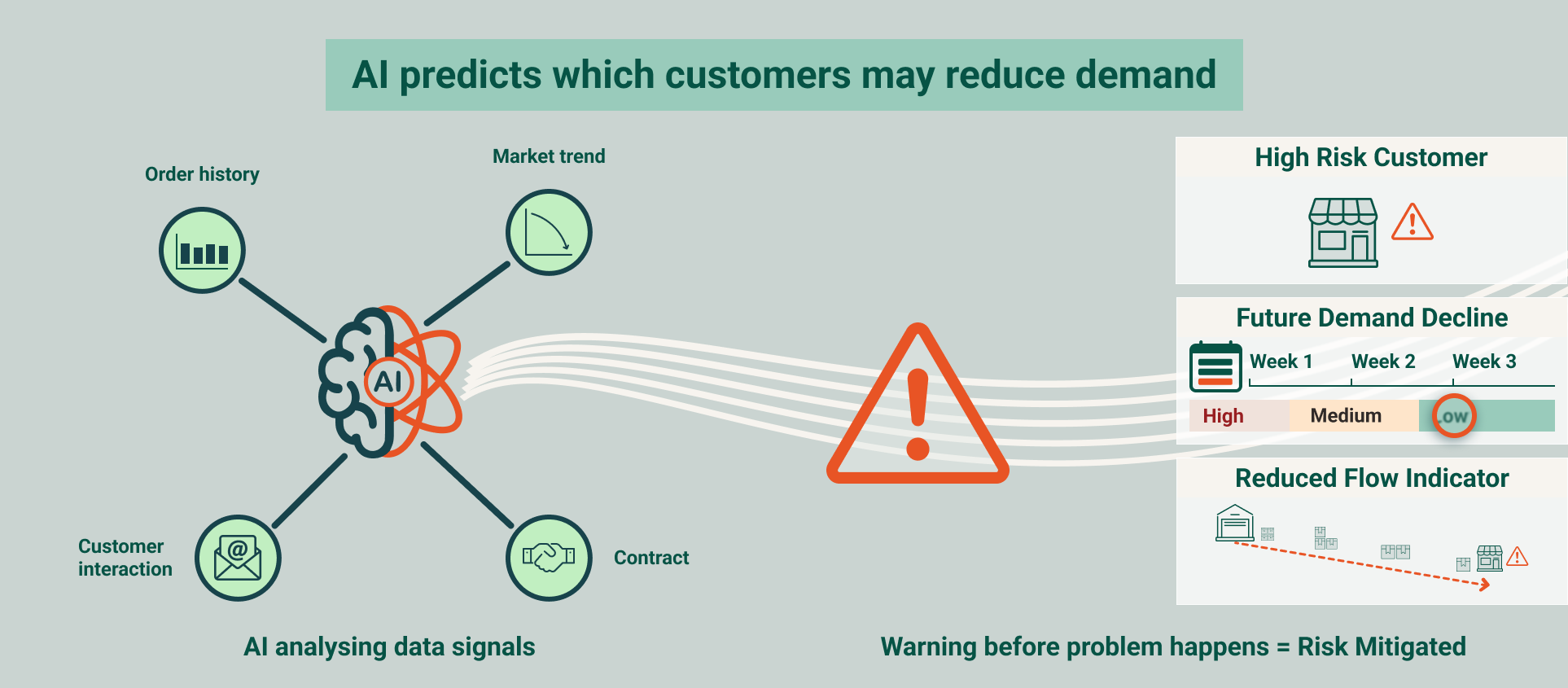
Predictive demand sensing analyzes how customers behave over time, identifying patterns that signal strengthening, stable, or declining demand.

It combines transactional and behavioral signals to estimate what is likely to happen next.

Key indicators include:

  • Changes in order frequency
  • Gaps between committed and actual volumes
  • Slower response or engagement patterns
  • External signals influencing purchasing behavior

This provides a forward-looking perspective on demand stability.

market demand sensing

Turning Insight into Better Decisions

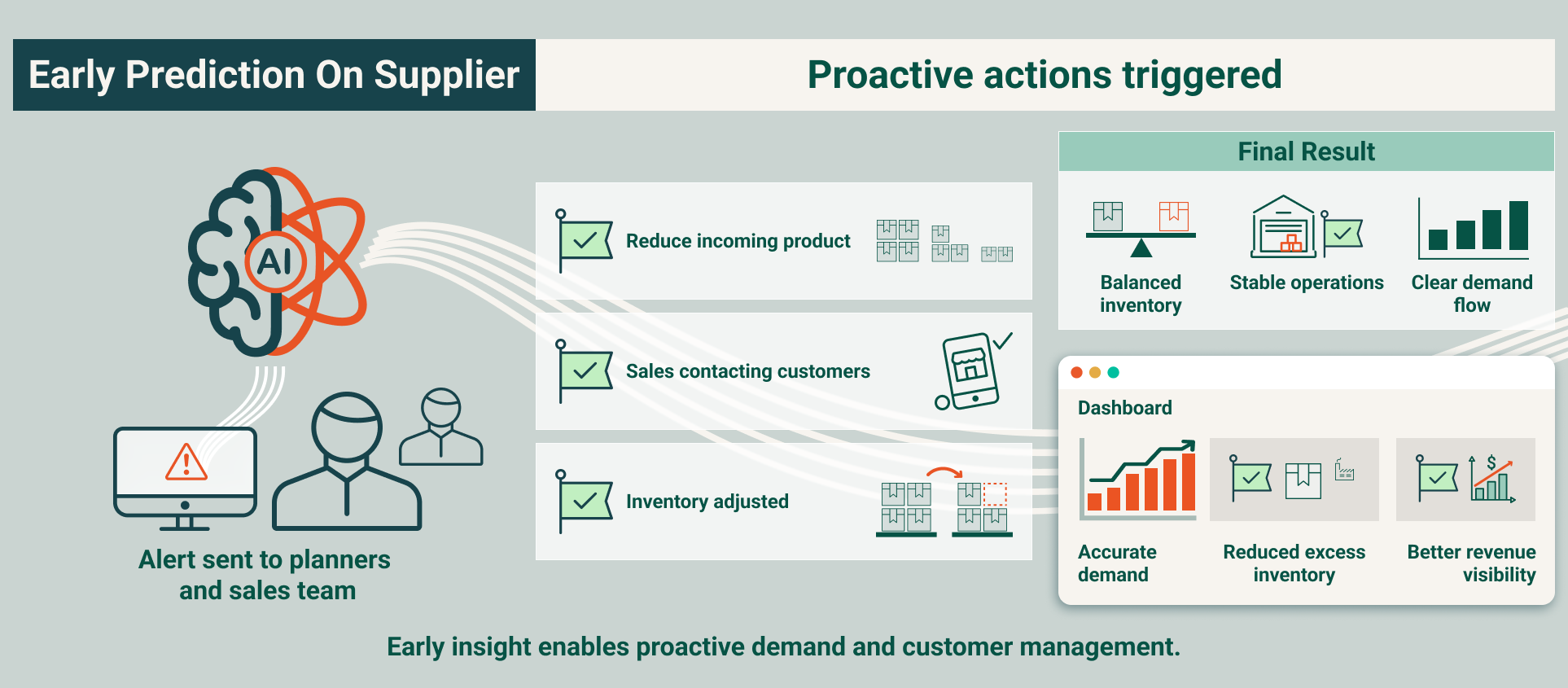
With clearer visibility, planning becomes more realistic. Forecasts reflect likely demand instead of historical assumptions, and production capacity can be aligned with more stable demand streams. Commercial teams gain time to engage at-risk customers before declines accelerate.

Aligning the Entire Value Chain

When demand signals are shared across functions, decisions become more coordinated. Procurement avoids overcommitting, inventory aligns with actual needs, and customer communication becomes more accurate. This reduces operational noise and improves overall stability.

market demand sensing

Measurable Impact

  • More reliable demand planning
  • Earlier identification of at-risk customers
  • Better alignment between inventory and actual demand
  • Improved capacity and resource utilization

A Capability That Sharpens Over Time

As more behavioral data is captured, the system continuously improves its ability to detect subtle demand shifts.

Over time, it becomes a critical input for both planning accuracy and customer relationship management.

Want to learn more?

With 20 + years of experience and more than 1,000 successful projects, Optilon helps companies design supply chains that work and keep improving.

Book a meeting with a supply chain expert to explore how predictive demand sensing can improve forecast accuracy, reduce demand uncertainty, and strengthen customer insights.
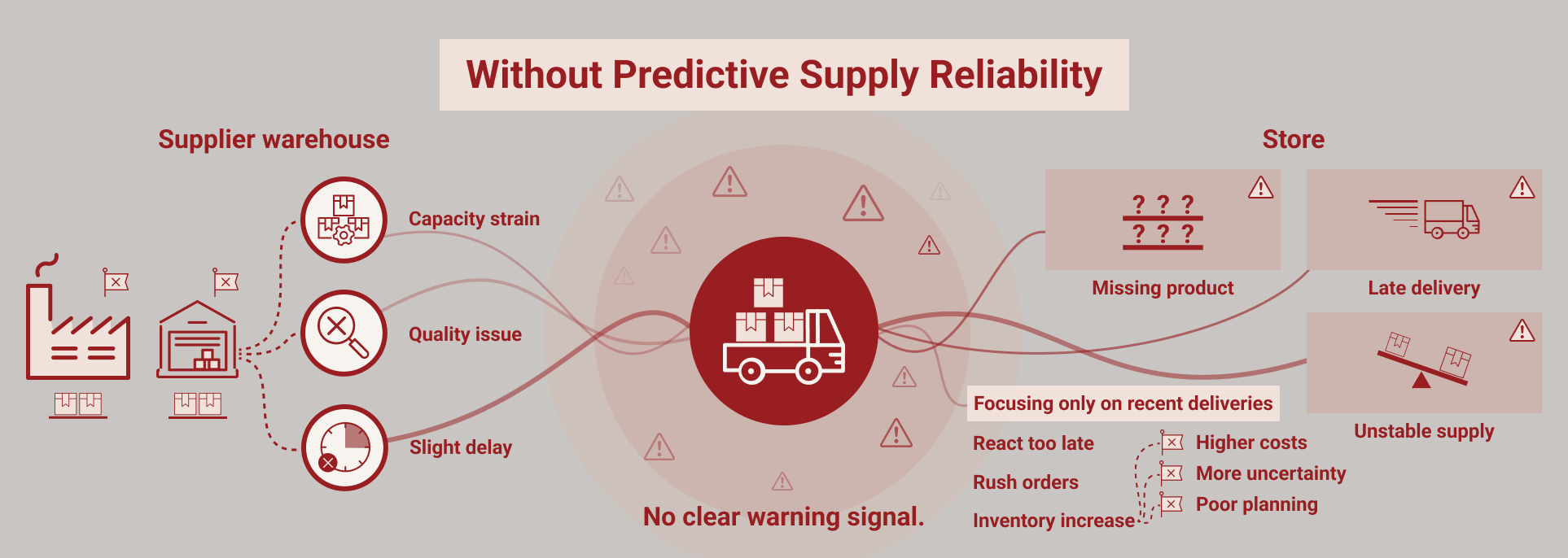
Supplier issues rarely appear overnight. Delivery precision weakens gradually. Lead times begin to slip. Responsiveness slows.

Individually, these signals are easy to overlook. Together, they point to emerging instability. By the time disruptions impact production or inbound flows, the problem is already established.

Seeing the Signals Earlier

Early signs of supplier risk often appear in patterns rather than events. Shipment timing drifts, confirmations take longer, and quality deviations increase subtly.

Without visibility into these changes, planning continues under the assumption that everything is stable.

predictive supply reliability

A Predictive Layer for Upstream Stability

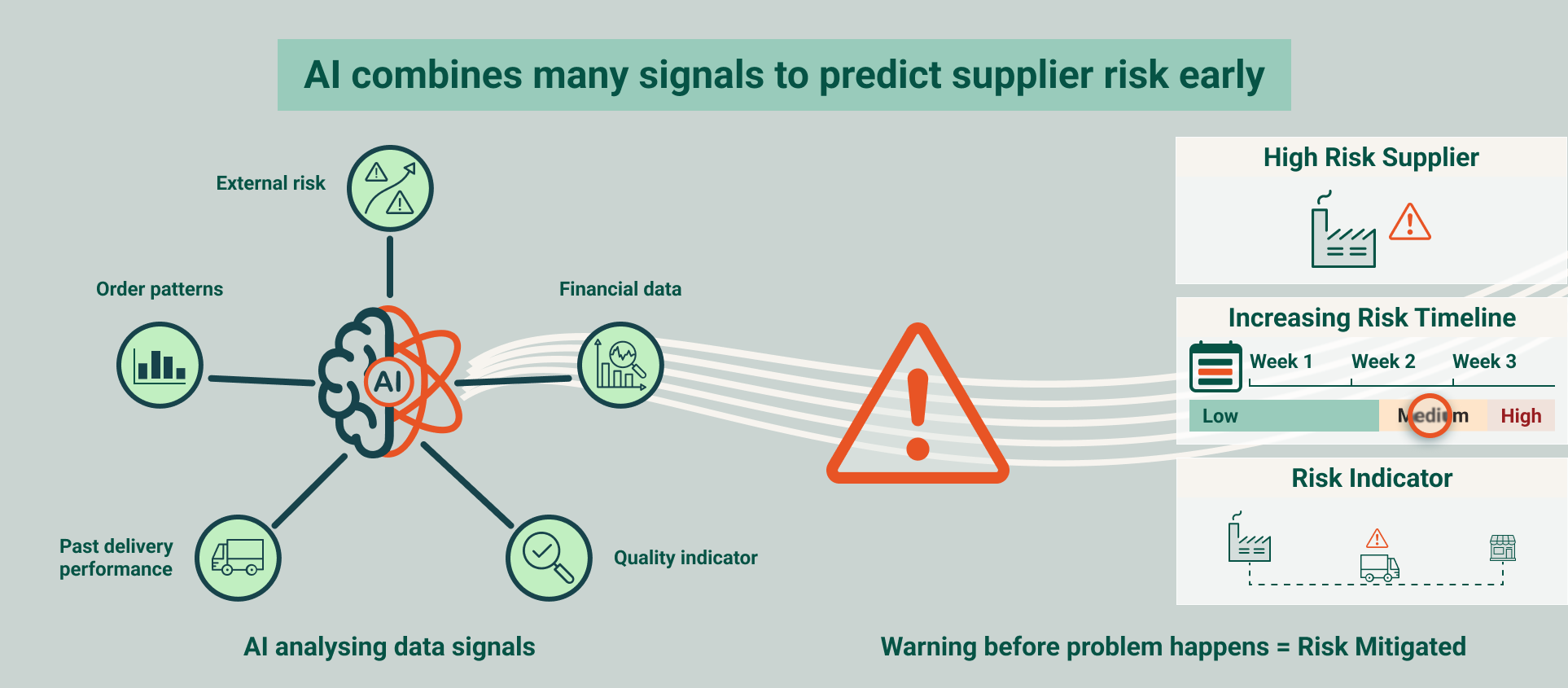
Predictive models connect signals across supplier behavior to identify where performance is likely to deteriorate.

They evaluate how delivery patterns evolve, detect when normal variation becomes risk, and highlight changes in responsiveness, capacity, and quality.

Key risk indicators include:

  • Delivery behavior drifting from established patterns
  • Capacity signals indicating upcoming constraints
  • Gradual changes in quality performance
  • Slower response cycles from suppliers


This creates a forward-looking view of supplier reliability.

predictive supply reliability

Turning Insight into Action

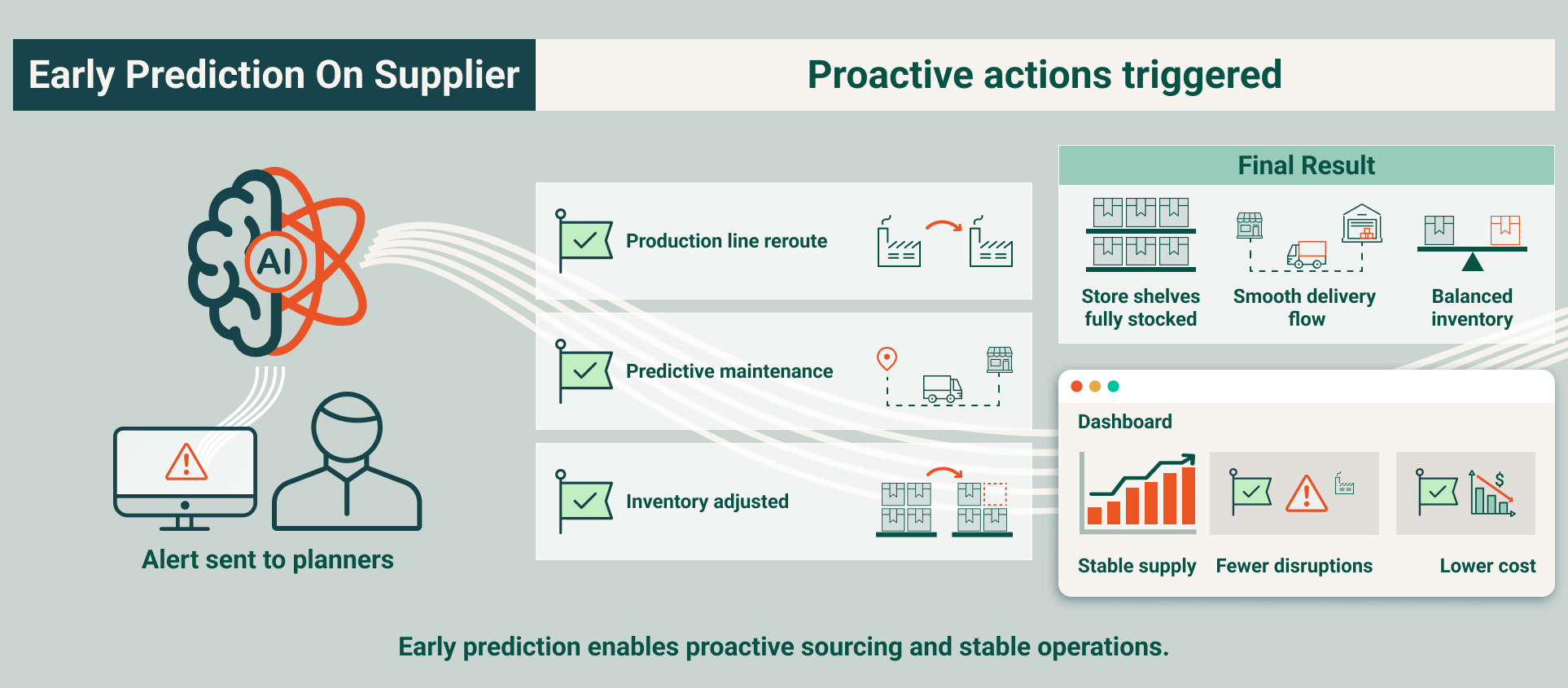
With earlier visibility, teams can act before disruptions escalate. Sourcing decisions become more targeted, safety stock is applied where it matters, and logistics gains time to adjust routing or timing. Instead of reacting to problems, organizations begin shaping outcomes.

Stronger Alignment Across Functions

Predictive visibility creates a shared understanding of risk. Production, procurement, logistics, and commercial teams operate from the same picture, reducing last-minute adjustments and improving coordination. Decisions become more aligned, and execution becomes more stable.

predictive supply reliability

Measurable Impact

  • Earlier identification of supplier risk
  • More targeted sourcing and mitigation actions
  • Fewer expedites and emergency interventions
  • More stable and predictable inbound flows

A Capability That Improves Over Time

As more supplier data is processed, predictions become increasingly precise. The system adapts to changing behaviors across regions and categories, strengthening resilience across the entire supply base.

Want to learn more?

With 20 + years of experience and more than 1,000 successful projects, Optilon helps companies design supply chains that work and keep improving.

Book a meeting with a supply chain expert to explore how predictive supply reliability can reduce risk, improve supplier performance, and strengthen upstream stability.

Contact us to book a meeting

By clicking “Submit”, I agree to Optilons privacy policy.